
When an OnlyFans agency moves from manual invoicing to an automated split, the team usually celebrates for operational reasons: no more spreadsheets, no more chasing transfers, a predictable weekly margin.
There's another side to that change that gets discussed less: what it's like for the creator.
Agencies sometimes assume creators prefer manual invoicing because it leaves them holding the full payout each week. For some that may be true. But many creators find the weekly routine of receiving a large payout and then sending part of it back more stressful than it looks from the agency's side. Here's why, and what an automatic split does and doesn't change for her.
1. The weekly request
In a traditional manual setup, the same thing happens every Monday. The full payout has cleared into her account and she can see the whole amount. Then the agency's invoice arrives, and she has to log into her banking app, enter the details and send a large transfer.
Even if she values the agency and agrees the split is fair, that is a recurring action that moves a lot of money out of her account. Behavioral economists describe loss aversion: people tend to feel a loss more strongly than an equivalent gain, and sending money away after seeing it land can feel like a loss even when it's an agreed payment. It's a normal human reaction, not a sign of a bad relationship.
An automatic split changes the mechanism, not the arrangement. The percentage is the same one she agreed to in the contract, and she can see it in her portal every week. What goes away is the weekly request: nothing arrives asking her to act, because her share and the agency's share were already settled when the payout landed.
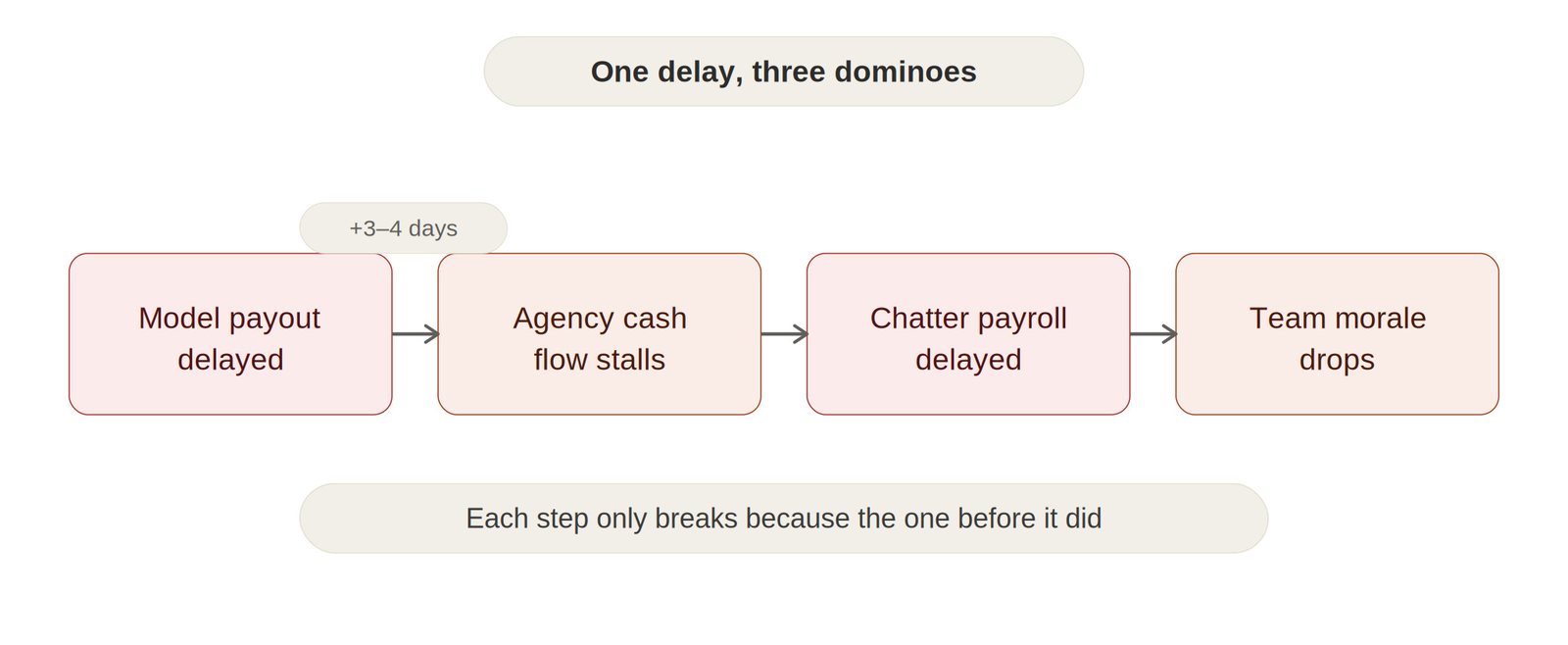
We cover the same dynamic from the agency's side in why creators resent manual invoices.
2. Seeing the same numbers
Most established creators know someone who was badly treated by a manager: tips left out, expenses inflated, chatter commissions miscalculated in a private spreadsheet. That history makes a lot of creators cautious, and a manual setup where the agency holds all the numbers invites suspicion whenever a payout comes in lower than expected.
A shared ledger addresses that directly:
- The same view for both sides. The agency and the creator each have their own portal showing the same bank-reconciled numbers.
- Itemized deductions. Platform fees, the contract split and the net amount are shown, so a lower-than-expected payout can be checked in a few seconds.
- No private spreadsheet in the middle. The numbers come from the bank-reconciled record, not from someone typing them in.
That doesn't make disagreements impossible, but it gives both sides one source to check instead of two. See also how to eliminate the "what did I earn" texts.
3. Keeping her own credentials
Some agencies try to solve the collection problem by holding the passwords and 2FA for an account in the creator's name. For an established creator, that can feel risky, and with good reason: if the relationship ends badly, or the agency is compromised, her identity and money are tied up in it.
When the split runs at the bank, she keeps her own login and her own verification. The agency never needs her credentials, because it doesn't need access to her account to receive its share.
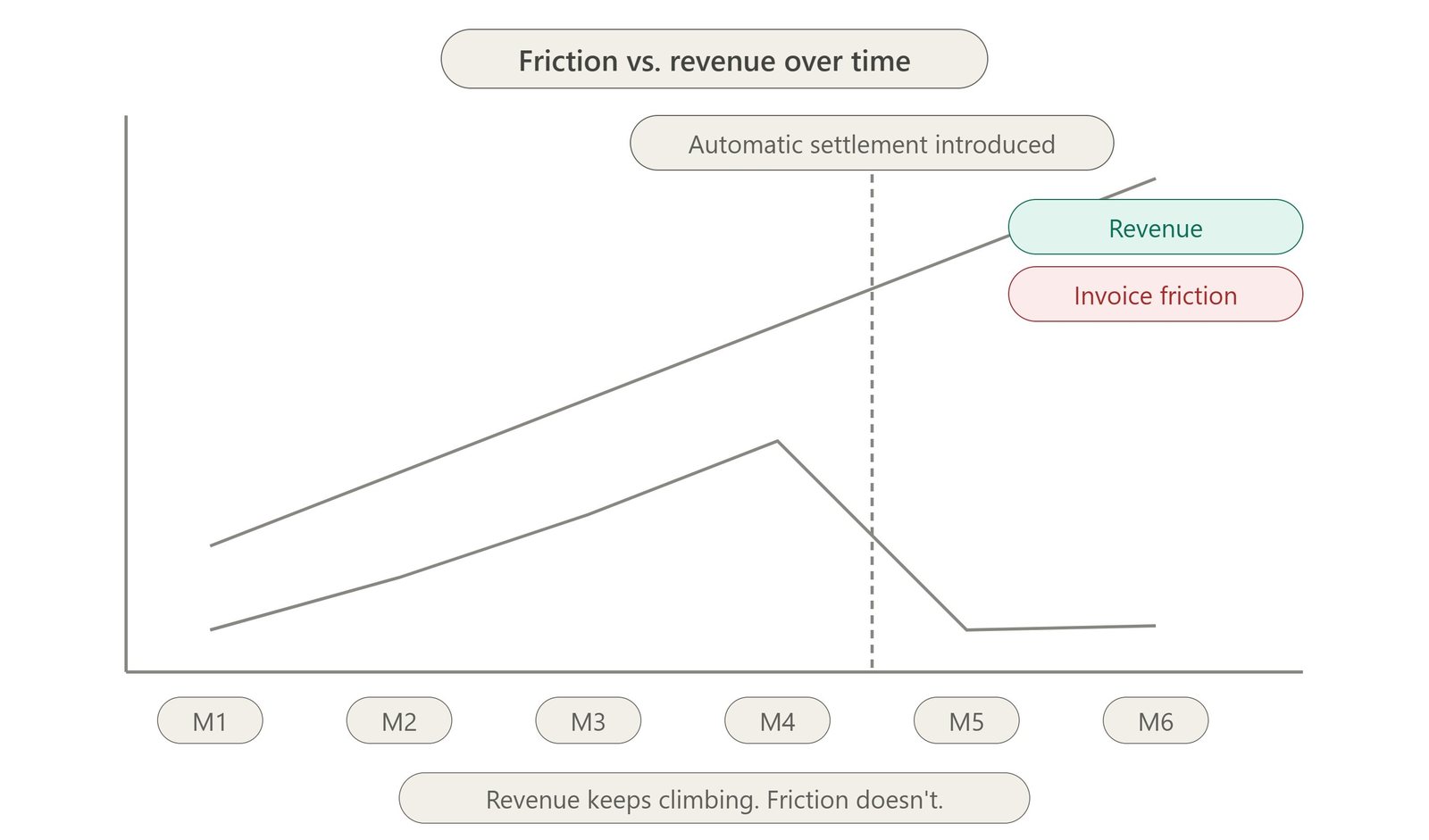
We explain how the two layers stay separate in how to separate account management from bank ownership.
What this means for retention
Money is one of the most common sources of friction between agencies and creators. A setup where nobody has to chase anyone, both sides see the same numbers and neither holds the other's credentials removes several of the usual friction points.
It doesn't replace the things that keep creators with an agency: results, communication and fair terms. A creator who isn't getting value for her percentage will notice the number whether or not an invoice arrives. The payout structure helps by taking money out of the list of things to argue about. It can't make up for a weak partnership.
Frequently asked questions
Do creators actually prefer automatic splits?
It varies. Many find a weekly manual transfer stressful and welcome not having to do it. Others want to keep control of the full payout. The best approach is to ask the creator and explain what she can see and control under each setup.
Does an automatic split mean she has less visibility into her earnings?
It shouldn't. A properly built setup shows her the agency's share and her own net amount every week, in her own portal. The split is automatic, but it isn't hidden.
Can a creator change or dispute the split after it's set?
The split follows the contract. If she wants to change the terms, that's done through a written amendment both sides agree to, and the system is updated to match. It isn't something either party changes unilaterally in the software.
Does this replace a good working relationship?
No. It removes one recurring point of friction, the weekly payment request, but the relationship still depends on results and communication.