In the early days of OnlyFans management, many agencies solved the collection problem the blunt way: they took control of the financial pipeline.
They set up digital wallets, neobank accounts or payout destinations in the model's legal name, but the agency held the logins, passwords and 2FA. The logic was simple. If the agency controls the login, the agency controls the money, and the risk of not getting paid goes down.
It did reduce the collection risk. But as the creator economy has matured, banks, payment providers and platforms have paid much closer attention to accounts where the named holder and the person actually operating them are different. Mixing page management with bank account ownership has become one of the more common reasons for frozen accounts and lost balances.
Scaling an agency safely means keeping those two layers apart. Here's what that looks like in practice.
1. Why the shared-access approach keeps breaking
Operating inside a creator's personal financial account creates several risks at once. We cover them in detail in [why using Paxum or Revolut in a model's name eventually causes problems](/blog/paxum-revolut-onlyfans-agency-account-freeze), so here's the short version:
- Identity verification you can't complete. If a provider puts a hold on the account and asks the account holder for a live identity check, only she can complete it. An agency holding her login can't.
- Legal exposure. Accessing an account registered to someone else, even with her permission, may be treated as unauthorized access under some providers' terms and some jurisdictions' laws. If the relationship sours, she's the account holder and the one a bank will listen to.
- Platform flags. If the page is operated from one location while the linked payout account is accessed from another, the pattern can look like third-party control of her account, which platforms tend to take seriously.
All three come from the same root cause: the agency's operational role and the creator's financial ownership are tangled together.
2. The alternative: financial sovereignty for both parties
The cleaner model is for each party to keep full control of its own money.
The agency is an independent business providing growth, marketing and chatting. The creator is an independent business providing content and her brand. The contract defines a revenue share. The financial setup should make sure neither side ever holds the other's logins.
The challenge is doing that without bringing back the collection problem. The answer is to execute the revenue split downstream, at the banking layer, through a regulated partner and not through either party's access.
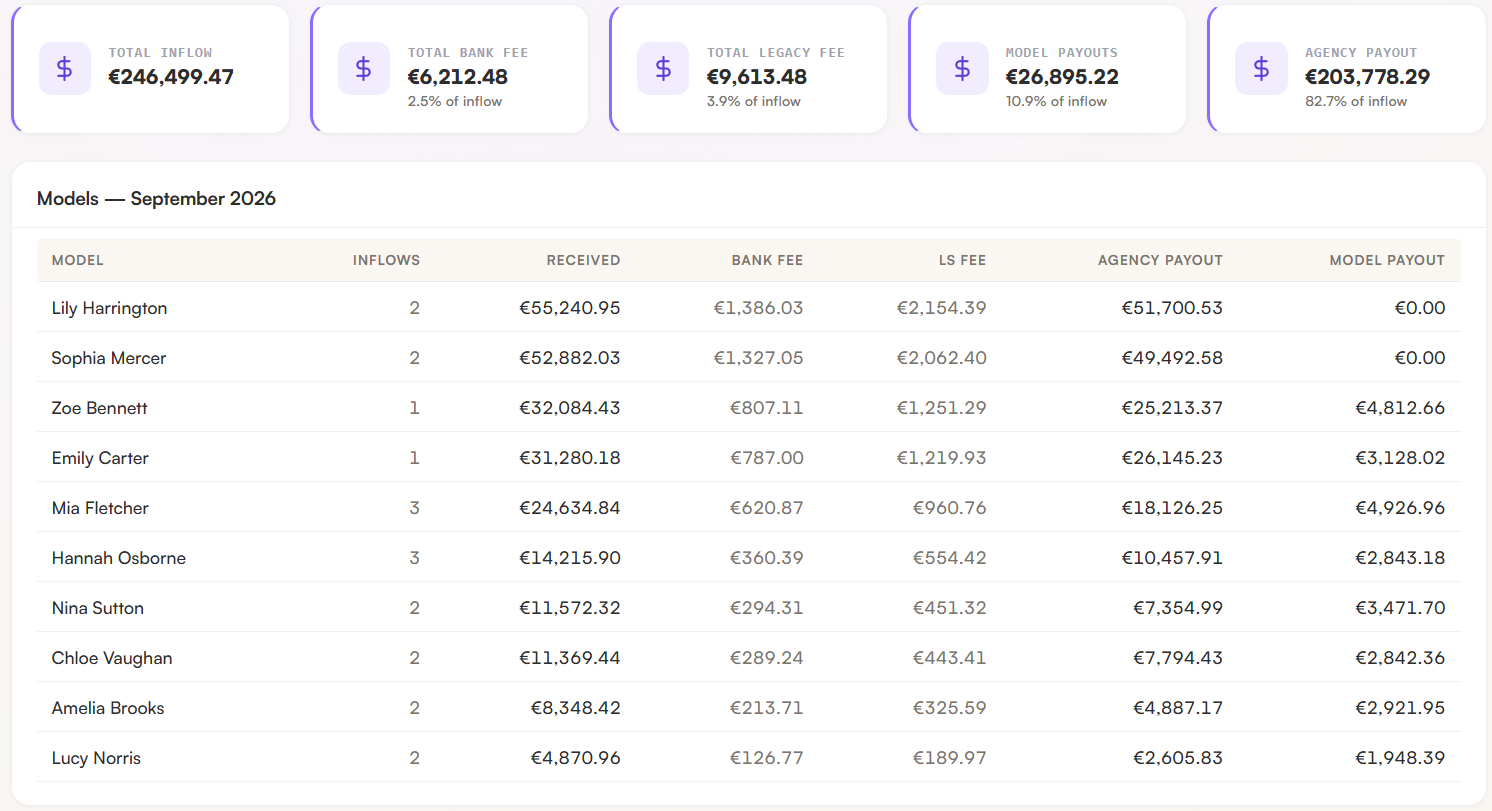
Here is how Legacy Solutions separates the two layers:
- Independent onboarding for both sides. The agency completes corporate verification. Each creator completes her own legal ID and KYC process.
- A dedicated account in the creator's own name. A licensed banking partner provisions it. It matches her verified identity, which is what OnlyFans' payout settings expect.
- An automated split when funds arrive. When the weekly payout lands in her account, a pre-authorized instruction executes the agreed split.
- Separate settlement. The agency's percentage goes to its own business account. The creator's share goes to hers.
Neither party ever has the other's credentials. The agency manages the page. She owns her account. The split happens at the bank, based on terms both sides agreed in the contract.
3. What separating the layers changes for an agency
- Less exposure to freezes caused by shared access. If managers never hold a model's banking credentials, the specific risk created by shared logins goes away. That doesn't make an account immune to review. Providers run compliance checks for many reasons.
- A stronger position with experienced creators. Established creators are often cautious about handing over banking access, and many have had a bad experience with it. An agency that doesn't ask for it can be a more credible partner.
- Cleaner financials. A business that runs on shared passwords and informal transfers is harder to audit, finance or sell. One where every split is a documented bank transaction is easier for a buyer, investor or lender to evaluate.
Frequently asked questions
Why do agencies end up sharing banking access in the first place?
Usually to solve the collection problem. If the agency can log in and move its share itself, it doesn't depend on a model forwarding a transfer. It solves one problem and creates the account-ownership risks above.
Can an agency manage a creator's OnlyFans page without touching her bank account?
Yes. Page operations (content, chatting, traffic) and payout accounts are separate systems. A split executed at the banking layer means the agency gets its share without needing access to hers.
Does separating the two layers eliminate every compliance risk?
No. It removes the risk caused by shared credentials and unclear account ownership. Banks and platforms can still review an account for other reasons, which is why clean documentation matters either way.
Is it legal for an agency to receive a percentage automatically?
Generally yes, when a licensed banking partner executes the split under an agreed contract and each party holds its own account. The legal problem is an agency controlling an account that isn't legally its own, not the percentage itself.