When you first sign a new creator to your OnlyFans management agency, the relationship usually starts well.
She's glad to have professional backing. You agree on a split, 70/30 or 60/40. At this stage, the agency is clearly the thing taking traffic acquisition, content scheduling, and 24/7 chatting off her shoulders.
When the first payouts clear and she's making $3,000, sending a $900 invoice feels straightforward. She pays it without much thought.
Scale that same page past $50,000 a month, and something shifts. The same creator who used to reply within minutes now delays payments, questions invoices, and goes quiet on Telegram.
This isn't a character change. It's a predictable result of how the payout is structured, and it's worth understanding clearly, not as a psychological weakness to route around, but as a real friction point to actually remove.
1. Why the same split feels different at scale
Part of what's happening is a well-documented pattern in behavioral economics called loss aversion, people generally feel the pain of losing something more intensely than the pleasure of an equivalent gain. It's not specific to this industry; it shows up any time money changes hands after it first lands in someone's possession.
Here's the mechanic:
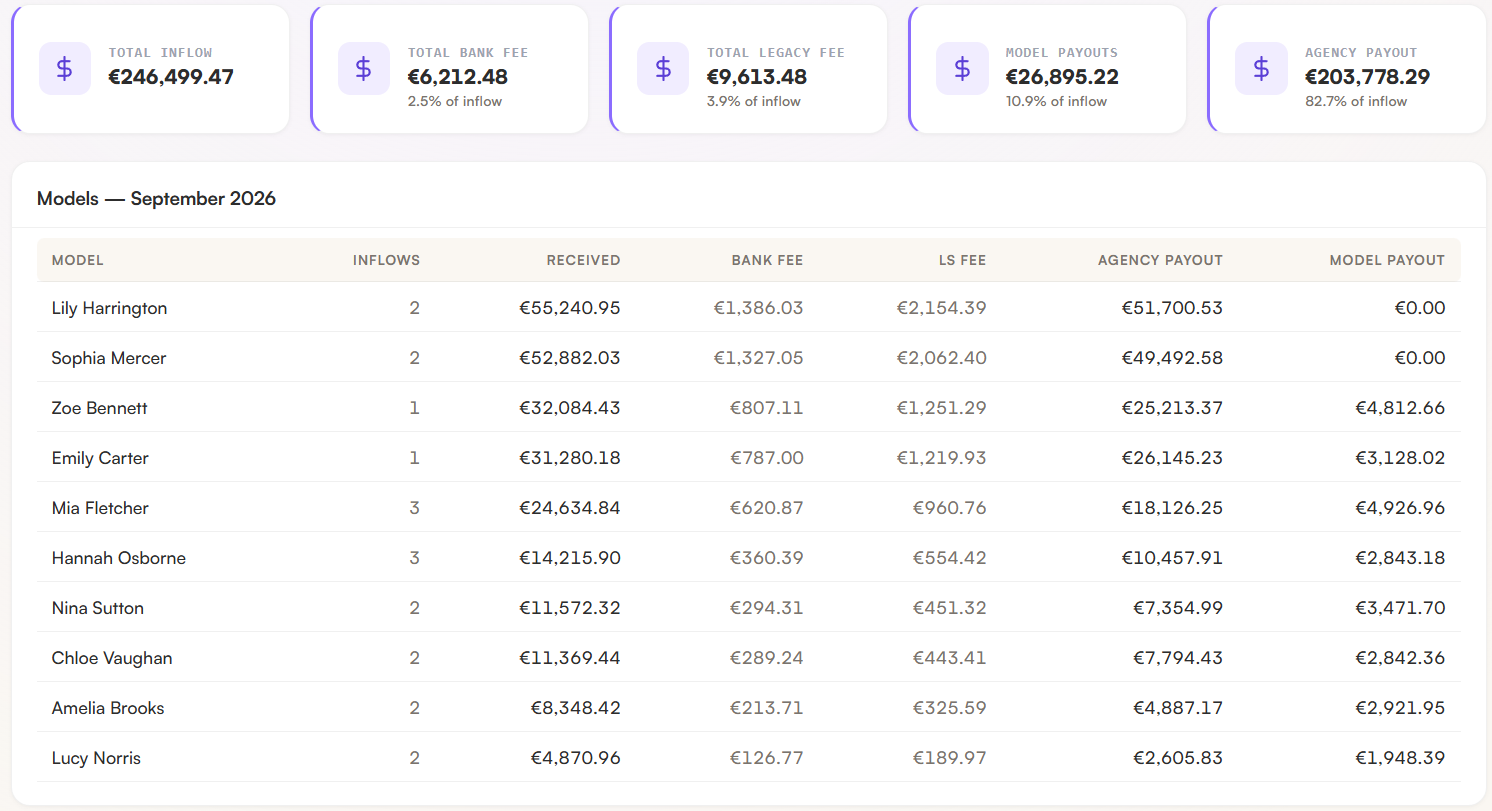
- OnlyFans releases a weekly payout, say $15,000.
- Due to the platform's own KYC rules, the full amount lands directly in the model's personal account.
- For a day or two, she's looking at that full balance as hers, because right now, it legally is.
- The agency then sends an invoice for its 30% share, $4,500.
That $4,500 is legitimately owed for real work. But because it's being requested *after* the full amount already landed and was seen, sending it feels like an active loss rather than honoring an agreement made in advance. That's not her being unreasonable, it's what happens whenever a split is structured as "receive everything, then give some back" instead of "receive your share, already final."
2. Why the agency's work becomes harder to see at scale
When an account is small, a model sees an agency's effort directly, constant messaging, hands-on setup, visible guidance.
As an account scales and the operation gets more efficient, a lot of that work becomes less visible by design, that's what a well-run operation looks like. Traffic routing, a trained chatting team covering shifts, ongoing optimization, none of it shows up in her day-to-day the way early hands-on setup did.
That's a real communication gap, not something to manage around psychologically. A model asking "what exactly am I paying 30% for" at scale is asking a fair question, and the honest answer is to make that work visible, regular reporting on what the agency is actually doing, not to make the invoice itself less noticeable so the question doesn't come up.
3. Why resentment creates room for competitors, and what actually closes it
Once a model is earning well, other agencies notice, and DMs follow. A rival citing a lower percentage is a real, ongoing competitive pressure in this industry, worth taking seriously on its own terms.
Friction around invoicing makes that pitch land harder, if the relationship already feels tense on a Monday, a lower-cut offer is more tempting than it might otherwise be. But the fix for that isn't making her less aware of what she's paying, it's making sure what she's paying is clearly justified and the payment itself doesn't create a recurring point of friction. A fair split, delivered cleanly, holds up against a competitor's pitch far better than an obscured one does.
The actual fix: remove the timing gap, not the visibility
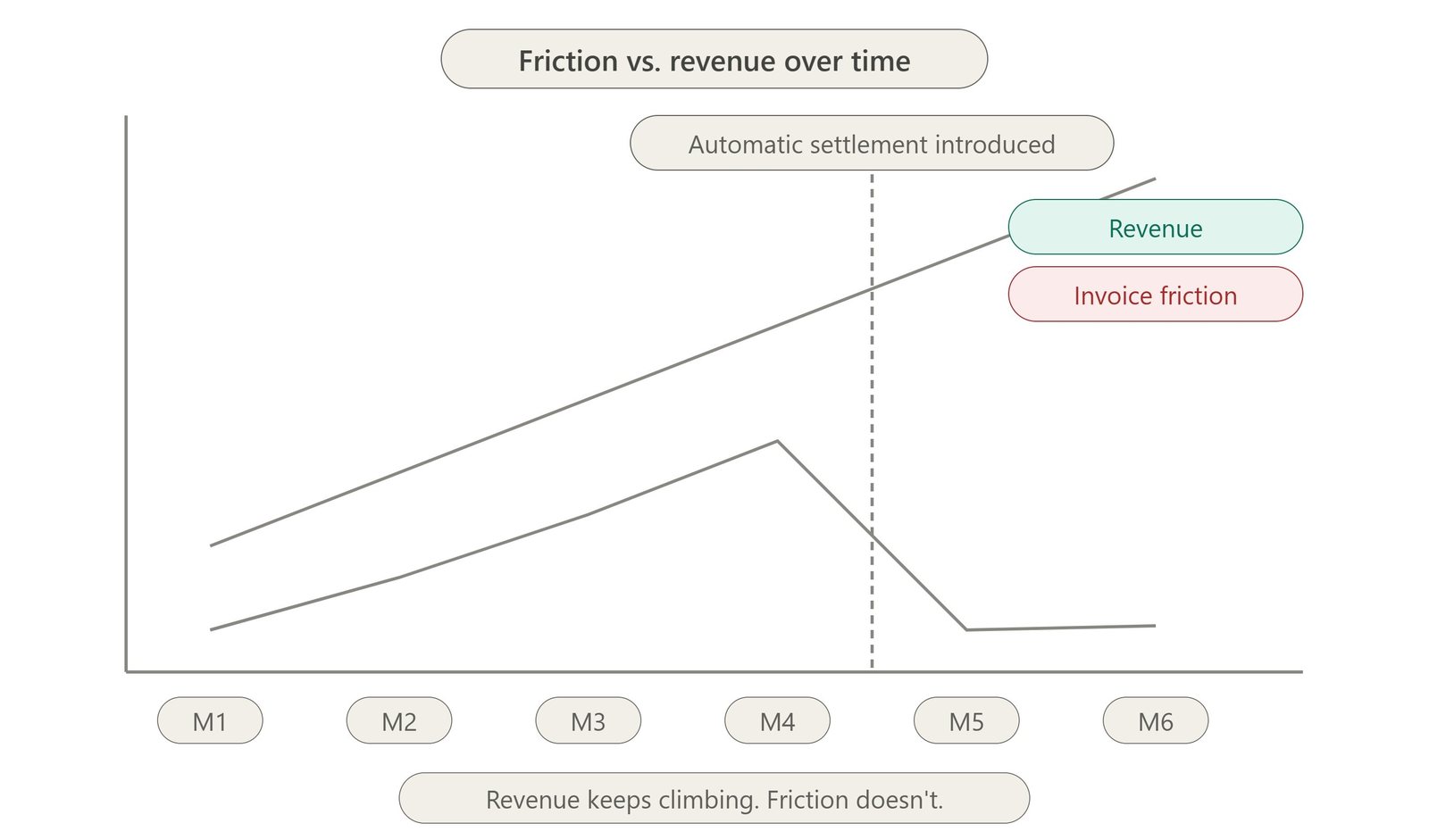
None of this gets solved by better wording on a reminder message or a tighter contract clause. The friction comes from the structure: the full amount lands, then a separate request follows. Removing that gap is what changes the dynamic, not making the split less visible to her.
This is what Legacy Solutions is built around, splitting revenue automatically at the banking layer so neither share is "given back" after the fact.
- Real verification, both sides. The agency completes corporate onboarding, each model completes her own legal ID and KYC process.
- Automated settlement. The moment OnlyFans releases the cleared balance, funds route through a licensed banking partner automatically, before landing as one undivided amount anywhere.
- Both shares final, at the same time. The agency's fee lands in its own account. The model's share lands separately in hers. Neither is calculated or requested after the other.
What actually changes for the model
With the split settling automatically, a model isn't asked to hand anything back after the fact, because nothing was ever fully hers to begin with, both shares were final from the moment the payout landed. That removes the specific Monday friction this article is about.
It doesn't mean she stops asking what she's getting for the percentage she pays, and it shouldn't. That's a fair question in any professional relationship, and answering it honestly, with real reporting on what the agency actually does, is what keeps the relationship solid, not removing her ability to notice the number.
Frequently asked questions
Is it normal for a model to question her agency's cut as her income grows?
Yes, and it's a reasonable question rather than a sign of a bad relationship. Larger numbers naturally invite more scrutiny, and an agency that can clearly show what it does for that percentage is in a stronger position than one relying on the model not looking too closely.
Does automatic settlement stop models from comparing offers from other agencies?
No, and it shouldn't try to. It removes a specific point of recurring friction, the delayed invoice, but a fair, competitive split and clear communication about value are still what actually keep a model from leaving.
Is it legal for an agency to automatically take its commission this way?
Yes, when the split is executed by a licensed banking partner based on an agreed contract, with each party holding its own account. The legal question is about account ownership and control, not about removing an invoice step.
How is this different from just asking the model to trust the agency more?
Trust matters, but it isn't infrastructure. Automatic settlement doesn't depend on either side's mood in a given week, it changes the structure so there's no delayed request for either side to feel friction about in the first place.