It's Thursday night. Dinner, family time, finally a few hours away from the screen.
Then the phone buzzes. It's the top-earning creator.
"Hey, do you know what my total earnings look like for this week? Trying to plan some expenses and want to make sure the chatters are hitting their targets. Let me know!"
It reads as a harmless question. Managing 5, 10, or 20 models, these texts add up fast. The team drops what it's doing, logs into multiple OnlyFans dashboards, exports statements, calculates platform deductions, applies the contract split, and types out an update by hand.
When creators keep texting for financial clarity, that's not impatience. It's a sign the agency's financial pipeline doesn't give her visibility on her own, so asking is the only option she has.
The real cost of information asymmetry
Information asymmetry, one party holding the data, the other having to ask for it, isn't just inconvenient, it actively creates problems of its own.
When an agency runs on manual tracking spreadsheets, only the agency can see the full picture. The model has to ask to find out what she actually earned after fees and the agreed cut. That gap tends to produce three specific patterns:
- Suspicion by default. Without real-time visibility into her own net earnings, a lower-than-expected payout reads as a possible miscalculation or a larger cut than agreed, even when nothing's actually wrong. Not seeing the number invites the worst interpretation of it.
- The gross-number mismatch. She sees the gross figure fluctuating on her live OnlyFans dashboard and mentally accounts for that number. When the reconciled net amount lands lower, due to platform fees or chargebacks she never saw itemized, it feels like a surprise rather than an expected deduction.
- The interruption cycle. Account managers end up doing manual bookkeeping instead of running traffic strategy, every financial question becomes a task that pulls someone off higher-value work.
Trust isn't built with promises, it's built with shared data
A common fix is being more responsive, replying faster, sending reassurance, screenshotting the spreadsheet more often. That adds manual steps to an already fragile system rather than fixing it.
The actual fix is both sides looking at the same numbers, at the same time, without either one having to ask. That's not a trust problem to manage with better communication, it's a visibility gap to close structurally.
A shared, compliant ledger
Ending the "what did I earn" message loop means giving both sides a single source of truth that updates automatically, not a faster version of the manual update.
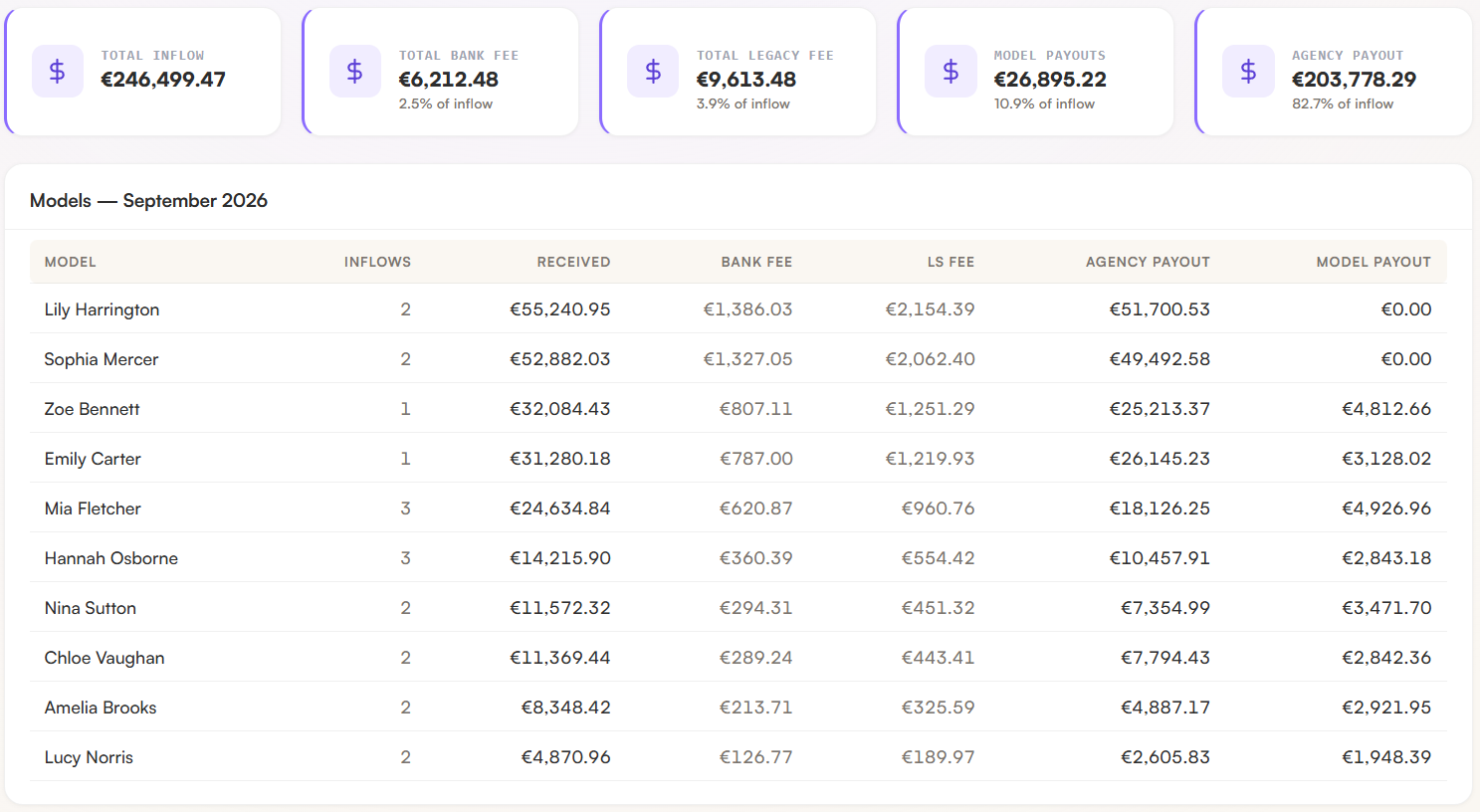
This is what Legacy Solutions is built around, financial infrastructure built with licensed institutions to give both the agency and the model the same real-time picture.
- Real compliance. The agency completes corporate onboarding, each creator completes her own legal ID and KYC verification.
- Real-time split tracking. When OnlyFans releases a payout, it routes through a secure banking node. The gross-to-net math, platform fees, and the agreed split all calculate automatically, updating both sides at the same time.
- Independent balance view. The model logs into her own portal and sees exactly what's hers, her actual net balance, not a gross number she has to mentally subtract an invoice from later.
What changes day to day
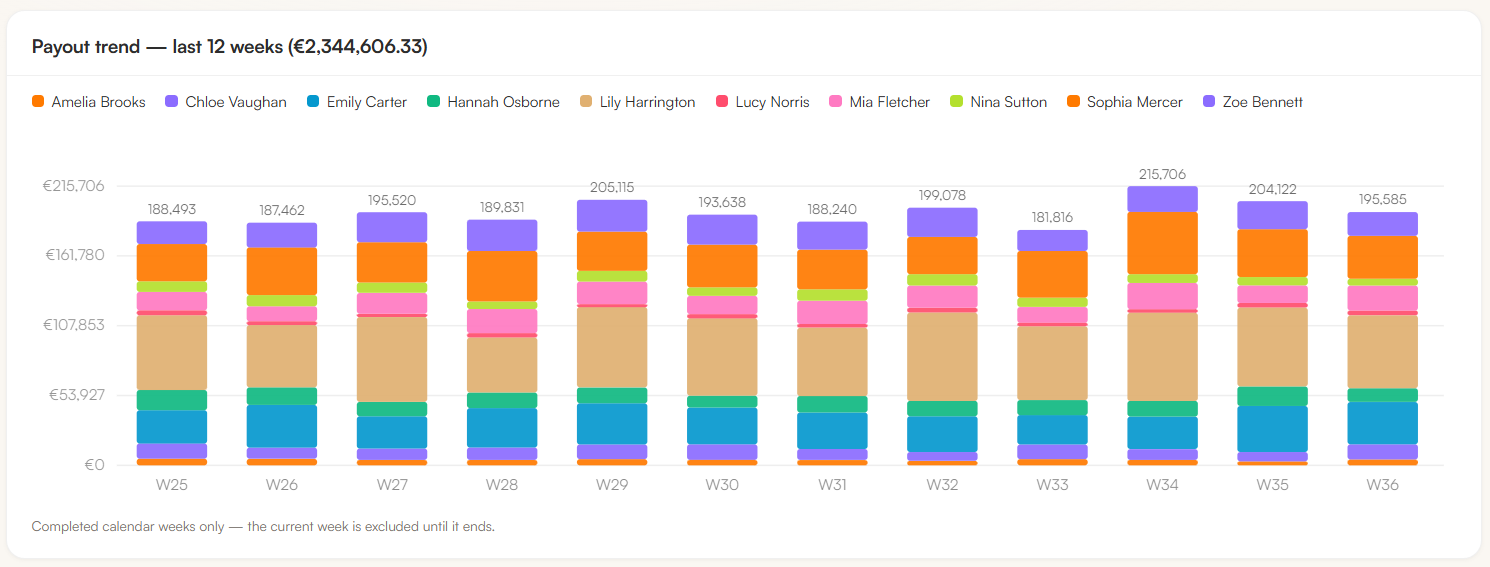
- The Thursday-night text stops. She can check her own portal whenever she wants, so there's nothing to ask about.
- Both sides see the same numbers. Bank-reconciled, identical on both ends, no formula errors or mismatched tracking to argue about.
- Account managers get their time back. Less time spent as an informal bookkeeping desk, more time on the work that actually grows accounts.
Frequently asked questions
Does giving a model real-time access to her own earnings create any downside for the agency?
Not typically. The agency's own share and fee structure stay exactly as agreed, visibility applies to her own net balance, not to internal agency financials beyond what's relevant to her split.
How is a shared ledger different from just sending screenshots more often?
A screenshot is a snapshot someone has to manually create and send. A shared ledger updates on its own and shows the same live numbers to both sides at the same time, nobody has to remember to generate or send anything.
Is it compliant to show a model her net balance with platform fees and the agreed split already itemized?
Yes, itemized, accurate reporting of her own earnings is a transparency practice, not a compliance risk. The relevant compliance questions are about how funds are held and moved, which a licensed banking partner handles, not about what she's shown.
Does this replace an agency's own bookkeeping or accounting?
No. It gives both sides accurate, real-time payout data, which generally makes bookkeeping and accounting easier since the underlying numbers are already reconciled, but tax filing and broader financial management still sit with the agency's own accounting process.