
A B2B banking solution for an adult agency is a way to receive, hold and split creator revenue through a licensed financial institution that knowingly works with the industry. For a European agency, it should mean accounts in the right legal names, an IBAN for each, clear documentation, and no need to describe the business as something it isn't.
Most agencies don't go looking for this until something breaks: an account closed without much explanation, a payout held for review, a wallet frozen. By then the choice is made under pressure. This guide covers the routes that exist, what to check in each, and the questions worth asking before you commit.
Why mainstream business banking is hard for adult agencies
The usual problem isn't anything the agency did. Several mainstream banks and payment providers state in their published policies that they don't serve adult content or related businesses, and others review these accounts more closely under their own risk rules. An agency can have a registered company and clean bookkeeping and still be refused, or approved and later closed.
That's why a business account opened under a generic description is fragile. If the bank finds out what the business does, the usual outcome is a review and often a closure. We explain the reasons in more detail in the complete guide to adult industry banking.
The three routes agencies actually use
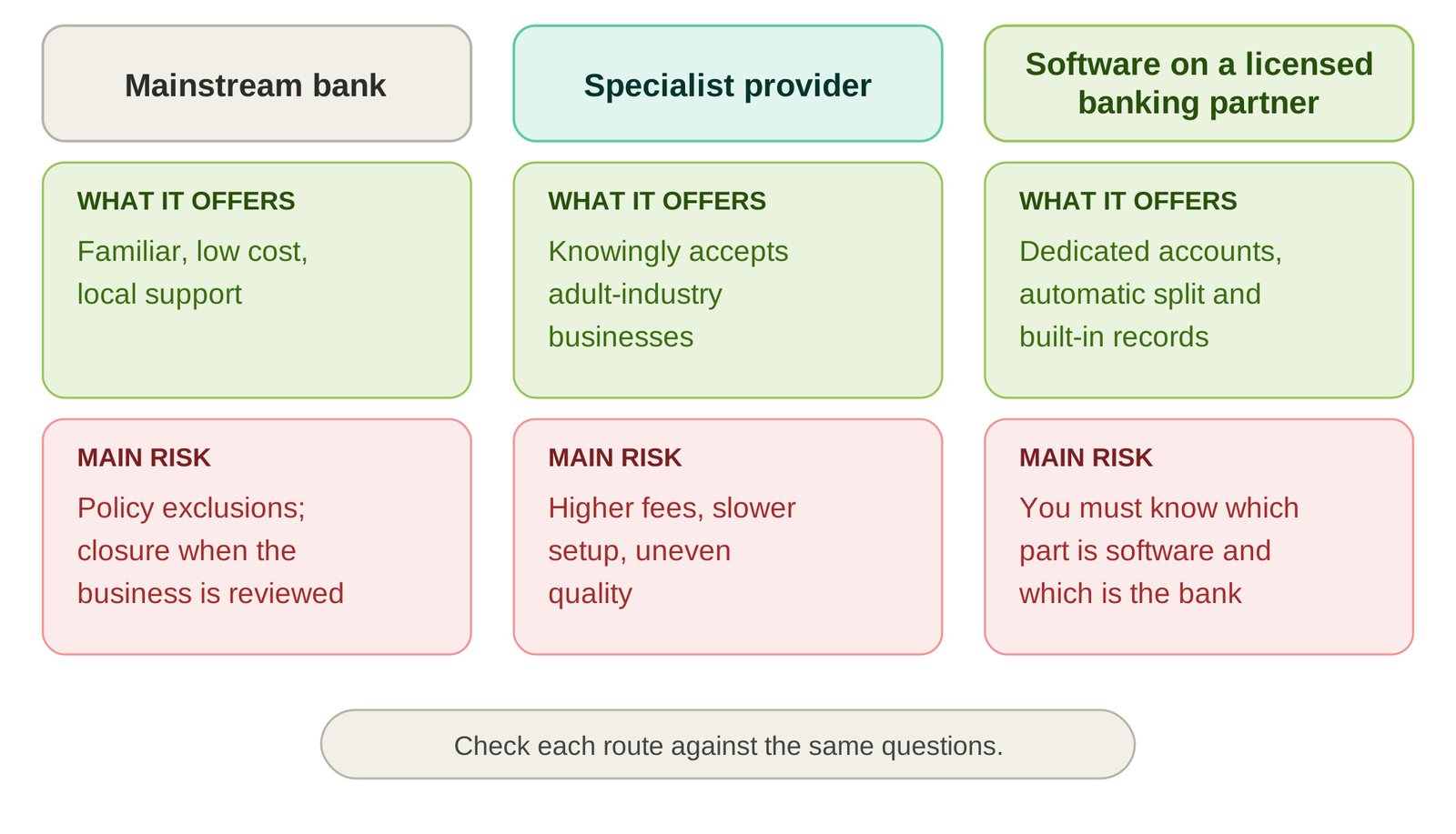
1. A mainstream business bank account.
- What it offers: familiar, low cost, local support.
- The risk: exclusions in the bank's own policy, and closure when the nature of the business becomes clear. Describing the business as something else to get approved makes this worse, not better.
2. A specialist or high-risk provider.
- What it offers: an institution that knowingly accepts adult-industry businesses and prices and structures accounts accordingly.
- The risk: higher fees, slower setup, and wide differences in quality. Some providers in this space are well run and some aren't, so each one needs checking.
3. Software on top of a licensed banking partner.
- What it offers: the accounts sit with a licensed institution, and software handles the setup, the split and the records.
- The risk: you need to understand which part is software and which part is the regulated institution. If a provider can't explain that plainly, treat it as a red flag.
None of these is right for everyone. A small agency with one or two models may be fine with a specialist account. An agency splitting revenue across many models and countries usually needs the third route, because the split and the records are the heavy part.
What a European agency should check
- Accounts in the right names. Each model's account should be in her own legal name, and the agency's in the agency's. Our guide to separating account management from bank account ownership explains why shared logins fail.
- An IBAN for each account. Euro payments across the SEPA area run on IBANs, so a European agency should expect a proper IBAN for each model and for itself, not a shared collection account.
- A licensed institution you can verify. Ask who holds the licence, and look the institution up on the register of the relevant national financial regulator. A provider that won't name the institution is not one to trust with other people's earnings.
- Verification on both sides. Real financial infrastructure checks the agency's company documents and each creator's identity. That's more work up front, and it's a good sign. See our onboarding checklist for what each side provides.
- Records you can export. Statements, per-model figures and an audit trail, in a format your accountant can use. See the financial records every agency should keep.
- Fees shown in full. Every fee as an amount and a percentage, with a worked example on your own volume.
- Honest descriptions. Nothing in the setup should depend on describing the business as something else.
Questions to ask any provider
Ask these in writing and keep the answers:
1. Which licensed institution holds the accounts, and where is it regulated? 2. Does it knowingly serve adult-industry agencies and their creators? 3. Whose name is on each account, and who holds the login? 4. What verification do you require from the agency and from each creator? 5. What happens to a creator's account if she leaves the agency? 6. What records can we export, and in what format? 7. What does it cost in total, with an example on our weekly volume?
Our longer list, seven questions to ask before choosing payout software, covers the same ground in more depth. For why generic payment gateways rarely fit, read which payment gateways support automated creator splitting.
Mistakes that cost agencies their accounts
- Misdescribing the business to get approved. It's a misrepresentation on a bank agreement, and discovery usually means closure.
- Running payouts through a wallet in the creator's name while the agency holds the login. It tends to fail the first time the provider asks the account holder to verify her identity. See why shared wallets get frozen.
- Taking promises as protection. No provider can promise an account will never be reviewed. Treat "100% safe" and "never frozen" as warning signs.
- Having no records to show. When a review does happen, the agencies that resolve it fastest are the ones that can produce a clear statement quickly.
Where Legacy Solutions fits
Legacy Solutions is the third route: software on top of licensed banking partners, built for creator agencies.
- A dedicated account per model. Each model has her own account in her own name, and her own login.
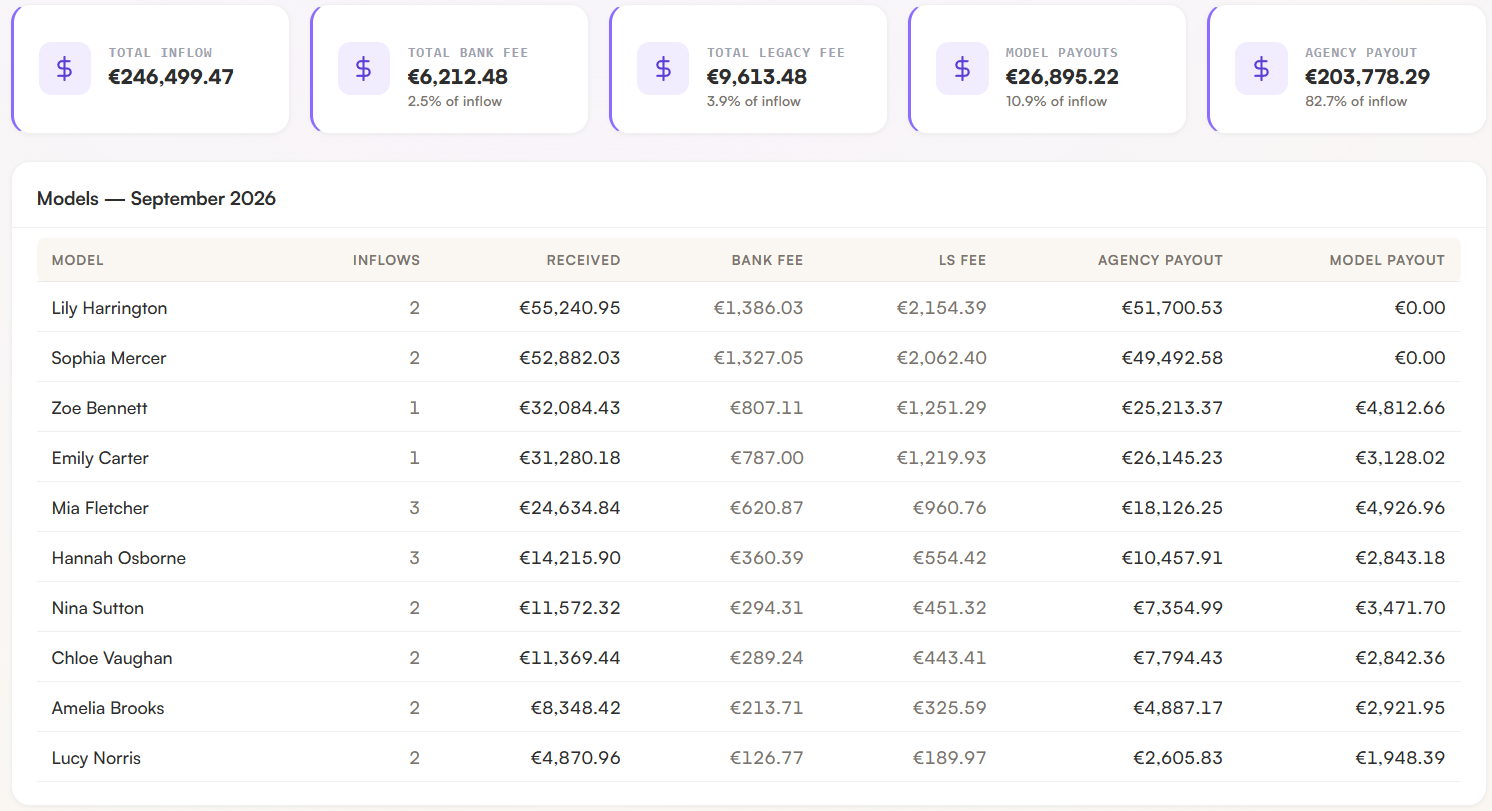
- A split at the banking level. The agreed split runs automatically when the payout lands, so the agency share and the model share go to their own accounts without a manual transfer.
- The same numbers for both sides. The agency and each model see the same figures in their own dashboards.
- Records built in. Statements download as PDF or CSV, and every fee is shown as an amount and a percentage of inflow.
Legacy is software only. It never holds, receives or transfers funds. The accounts and transfers sit with the licensed banking partner. We can't promise an account will never be reviewed. What the structure removes is the risk that comes from shared logins and mismatched account names.
If you'd like to see how it would work for your agency, you can apply at legacysolutions.vip. For the wider picture, see our banking stability page.
Frequently asked questions
Can an adult agency get a normal business bank account?
Sometimes, but it's fragile. Many mainstream banks exclude adult content in their policies, and an account opened under a different description can be closed when the business is reviewed. A provider that knowingly serves the industry is the more stable route.
Do European agencies need an IBAN for each creator?
Payments in euro across the SEPA area use IBANs, so each account should have its own. A dedicated account in the creator's own name is cleaner than a shared collection account, and it makes the records easier to follow.
How do I check that a provider is licensed?
Ask which institution holds the accounts, then look it up on the register of the national financial regulator for that country. If the provider won't name the institution, that's a warning sign.
Is a specialist provider better than a mainstream bank?
For an adult agency, usually yes, because it knowingly accepts the business. Quality varies, so check each one against the same questions.
Does software replace a bank?
No. Software like Legacy Solutions sits on top of a licensed banking partner and handles the setup, the split and the records. The accounts and the transfers stay with the licensed institution.
Can any provider guarantee an account won't be frozen?
No. Banks and platforms run checks for their own reasons. A good structure removes avoidable risks, such as shared logins and mismatched names, but nobody can promise it will never be reviewed.