It's a workaround used by a lot of scaling OnlyFans management agencies.
To solve the "Monday invoice problem," where the model receives 100% of the payout and occasionally doesn't forward the agency's cut, an agency sets up a digital wallet or e-payment account, Paxum, CosmoPayment, Revolut, Wise, under the model's legal name, but the agency holds the login credentials, passwords, and 2FA.
When OnlyFans releases the weekly funds, they land smoothly because the names match. The agency logs in, transfers its 30-50% cut to its own corporate account, and forwards the rest to the creator.
On paper, that solves the collection risk. In practice, it builds the agency's revenue on top of a compliance landmine. One automated flag can cut off access entirely. Here's why the shared-account workaround is a serious structural risk, and what actually replaces it.
1. The trigger: the high-volume compliance wall
Digital wallets and neobanks operate under anti-money laundering (AML) and counter-terrorist financing (CTF) regulations, enforced through automated fraud-detection systems that monitor account activity and access patterns.
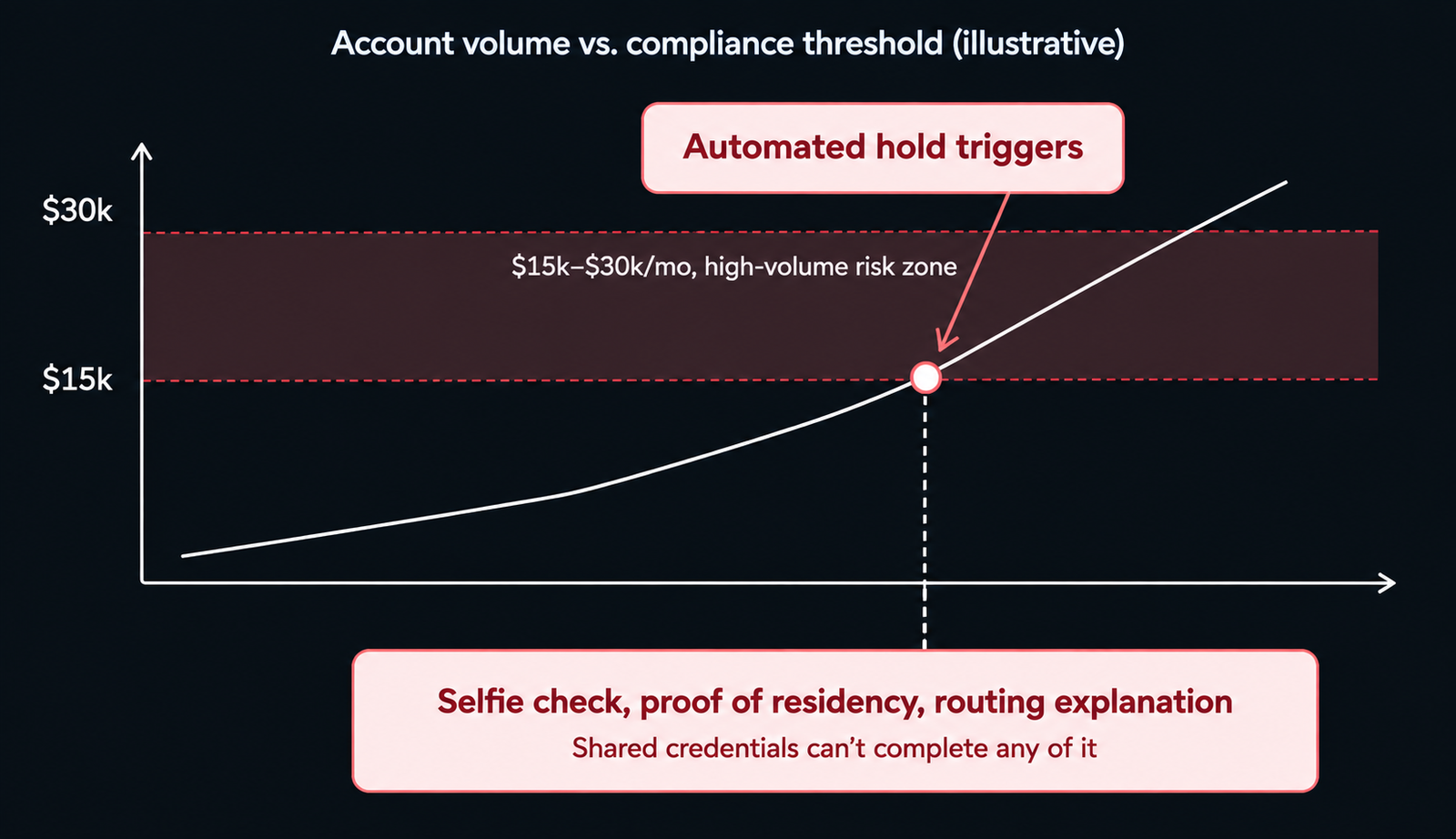
At $2,000 a month, these systems rarely react. Once an account scales past roughly $15,000 to $30,000 a month, it crosses into higher-volume risk territory, and an automated compliance hold can trigger without warning.
Lifting that kind of hold typically requires:
- A live facial verification (selfie check) from the account holder
- Current proof of tax residency or a recent utility bill matching the registration address
- An explanation for why funds are consistently routed to a third-party corporate account
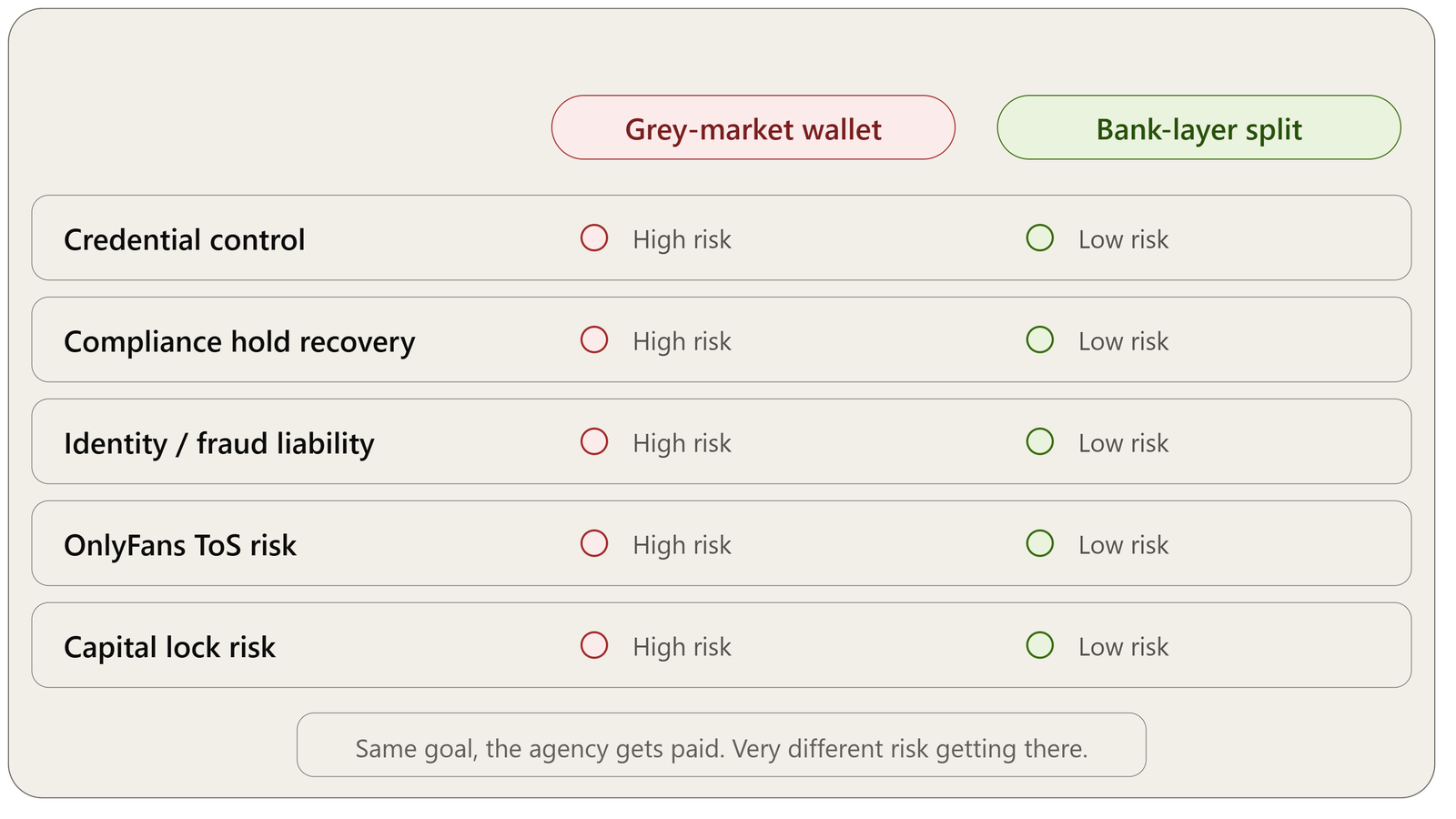
None of that can be completed by an agency holding shared credentials, it requires the actual account holder, in person, cooperative, and available. If she's unreachable, traveling, or simply doesn't respond in time, the account can stay locked, with the agency's accumulated margin sitting inside it.
2. The identity and fraud liability
Controlling a financial account registered under someone else's legal identity carries real legal exposure, a signed management contract doesn't change that, since most banking and wallet providers' own terms of service prohibit credential sharing regardless of any side agreement between the parties.
If the relationship sours, the named account holder can contact the bank or wallet provider directly and report the account as compromised, or the access as unauthorized. Because the account is legally hers, financial institutions and any subsequent investigation default to protecting the named holder, not the party who was actually operating it. That can lead to:
- Termination of the agency's own merchant or banking relationships
- Being flagged in fraud-prevention databases shared across financial institutions, which can make opening future business accounts significantly harder
- Loss of any pending balance held in that wallet at the time of the flag
3. The OnlyFans terms-of-service trap
OnlyFans enforces its own KYC requirements, and the payout routing path is expected to match the verified creator's legal identity documents.
If a shared-wallet setup produces a pattern OnlyFans' systems flag as suspicious, for example, the creator's page being operated from one location while the linked payout wallet is consistently accessed from an agency's location elsewhere, that pattern can be read as third-party financial exploitation of the account.
There's typically no warning before action is taken. The consequence can be a permanent account ban, a frozen rolling balance, and the creator barred from re-registering. In that scenario the agency loses the account, the client relationship, and that revenue stream at the same time.
Why this keeps happening despite the risk
None of this is because agencies are careless. Shared wallets solve a real, immediate problem, the Monday invoice problem covered in more detail in [the hidden cost of chasing OnlyFans revenue](/blog/chasing-onlyfans-revenue-hidden-system-cost). The workaround just trades a slow, visible cost (time spent chasing invoices) for a fast, invisible one (an account freeze that can happen without warning). It's a reasonable trade to make by accident, not a reasonable one to make on purpose once the actual risk is visible.
Separate accounts, both compliant
Scaling past this risk means both the agency and the model keeping independent financial standing, with the revenue split executed by a regulated third party rather than by either side controlling the other's credentials.
This is what Legacy Solutions is built around, not an unregulated app or a lightweight tracking tool, financial infrastructure built with licensed financial institutions to execute revenue splits at the banking layer, without either party holding the other's login.
- Full onboarding, both sides. The agency goes through corporate verification, and each creator completes her own legal identification and KYC process, the same standard covered in the [model onboarding checklist](/blog/how-do-you-legally-and-operationally-enforce-a-revenue-split-contract).
- Dedicated accounts per model. Each model holds her own compliant account through the banking partner. Neither party controls or has access to the other's credentials or 2FA.
- Automated settlement. The moment OnlyFans releases the cleared balance, funds route through the banking node automatically, the agency's management fee lands in its own corporate account, and the model's net share lands separately in hers.
No invoice goes out, because there's nothing pending to invoice, and no one on the agency side ever touches the model's personal financial credentials, because there was never a shared login to begin with. That combination is what actually keeps an agency's capital out of a freeze it doesn't control, not a workaround that happens to avoid detection so far.
Frequently asked questions
Is it illegal to hold a wallet or bank account under a model's name if she agreed to it?
The model's agreement doesn't override the banking or wallet provider's own terms of service, which generally prohibit credential sharing regardless of consent between the two parties. The legal exposure comes from operating an account that isn't legally the agency's, not from whether both sides considered it a fair arrangement.
How much monthly volume typically triggers a compliance hold on a shared wallet?
There's no universal number, it depends on the specific provider, but accounts scaling past roughly $15,000 to $30,000 a month are meaningfully more likely to cross into automated high-volume review territory than smaller accounts.
Can an agency get its funds back after a shared wallet gets frozen?
Sometimes, but it typically requires the actual named account holder to complete verification directly with the provider, which an agency can't do on her behalf. If she's unresponsive or unwilling, the funds can remain inaccessible indefinitely.
Does using a dedicated per-model account through a licensed banking partner remove this risk entirely?
It removes the specific risk created by credential sharing and unclear account ownership, since neither party holds the other's login. It doesn't eliminate every possible reason a bank might flag an account, standard compliance reviews can still happen, they just aren't triggered by an ownership or access problem that shared credentials create.