
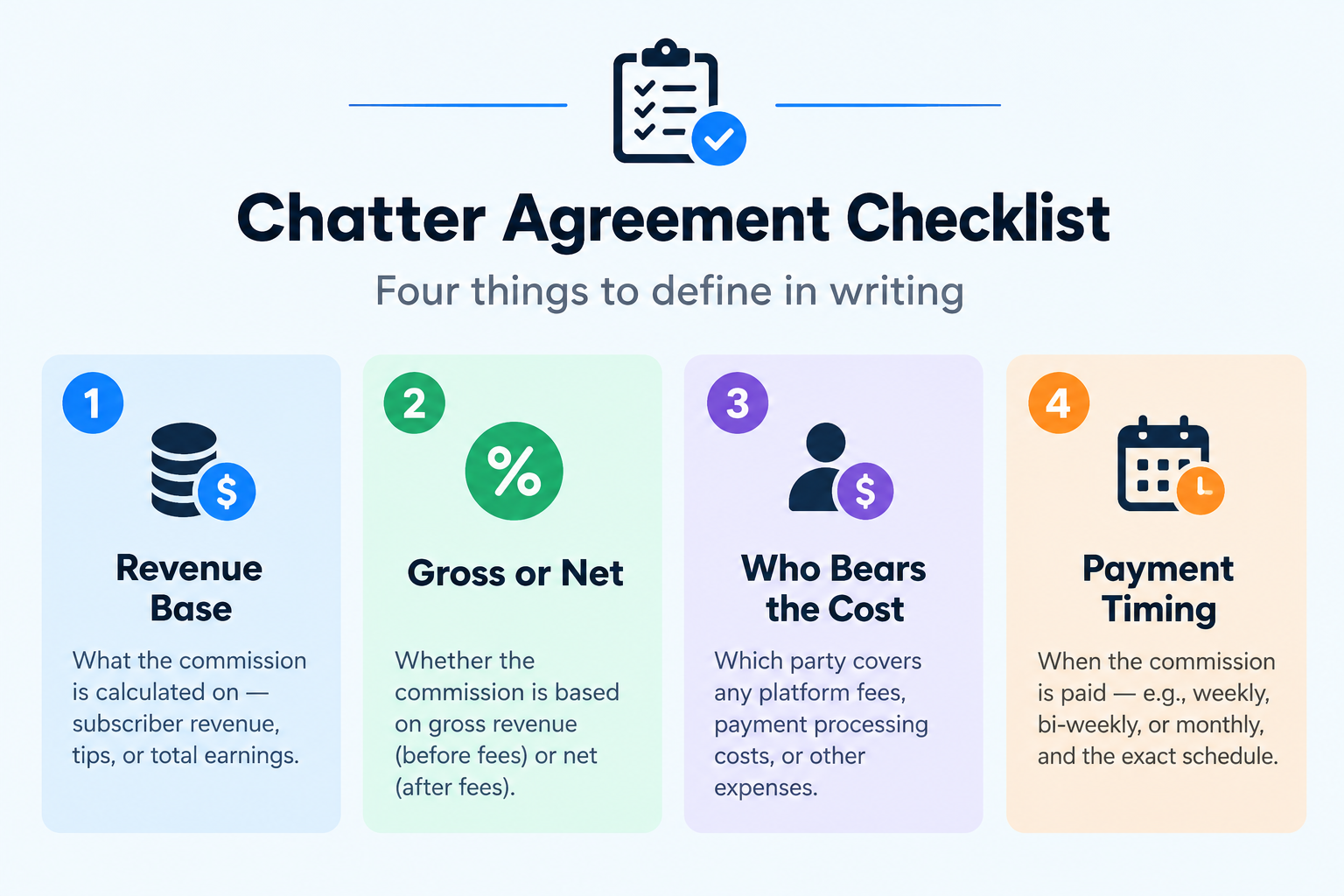
A chatter commission needs four things settled in writing: what revenue it applies to, whether it's calculated on gross or net, who bears the cost (the agency's share or the split pool), and when chatters are paid. Most disputes about chatter pay come from one of those being left open, not from the percentage itself.
Chatters often drive a large share of an account's direct-message revenue, so their pay sits right next to the agency-creator split. It also moves the numbers in both directions, which is why it's worth defining as carefully as the split itself.
1. How chatters are usually paid
There's no single standard, but three models cover most arrangements:
- Fixed pay. A set amount per hour, shift or month, regardless of sales. It's stable and predictable, and usually the lowest paying.
- Commission only. A percentage of what sells in the chats the chatter handles. There's no ceiling, and no floor either.
- Base plus commission. A smaller fixed amount plus a percentage of sales. Several published guides describe this as the most common setup on serious teams, because it rewards selling without leaving the chatter at zero in a slow month.
Published commission rates vary widely, from under 1% of PPV revenue in some guides to 15% of sales in others, depending on whether base pay is included, how large the account is and what the percentage applies to. Most of those figures come from recruiters and agency blogs, not a neutral source, so treat them as a rough range, not a benchmark. The number matters less than how it's defined.
2. The four decisions a chatter commission has to settle
What counts as the chatter's revenue. Is it only the PPV sales, tips and custom content the chatter personally closes in direct messages, or revenue from the whole page? These are very different amounts, and "5% of revenue" can mean either.
Gross or net. OnlyFans takes a flat 20% platform fee. A commission calculated on the amount fans spent is larger than the same percentage calculated on what's left after the fee. This is the same question we cover for the agency split in gross vs. net contract math, and it applies to chatters just as much.
Who bears the cost. Many agencies treat chatter pay as an agency cost and pay it out of the agency's own share. Others take it out of the pool before the split, so the creator effectively shares the cost. Either can work, but the contract with the creator has to say which, because the difference moves real money between the two of you.
When chatters are paid. Weekly, every two weeks or monthly, and from which date: the sale date or the date the payout clears.
3. A worked example
These numbers are illustrative, not typical rates. Say a creator's page takes in $50,000 in a month, and $30,000 of that came from sales a chatter closed in direct messages. The agency's split is 40% of net, and the chatter is on a 5% commission.
- OnlyFans takes 20% ($10,000), leaving $40,000 net.
- The agency's 40% of net is $16,000, and the creator's 60% is $24,000.
Gross or net chatter base.
- 5% of the $30,000 the chatter sold (before the platform fee) is $1,500.
- 5% of the same sales after the 20% platform fee ($24,000) is $1,200.
- Same 5%, $300 difference in a month, from one word in the agreement.
Who bears the cost (using the $1,500 figure):
- Paid from the agency's share: the agency keeps $16,000 minus $1,500, which is $14,500. The creator receives $24,000.
- Paid before the split: the pool becomes $40,000 minus $1,500, which is $38,500. The agency's 40% is $15,400 and the creator's 60% is $23,100.
The total is the same either way ($40,000 across agency, creator and chatter). But where the commission comes from moves $900 between the agency and the creator on one account in one month. Across ten accounts, that's a number worth agreeing in advance.
4. Tracking who closed what
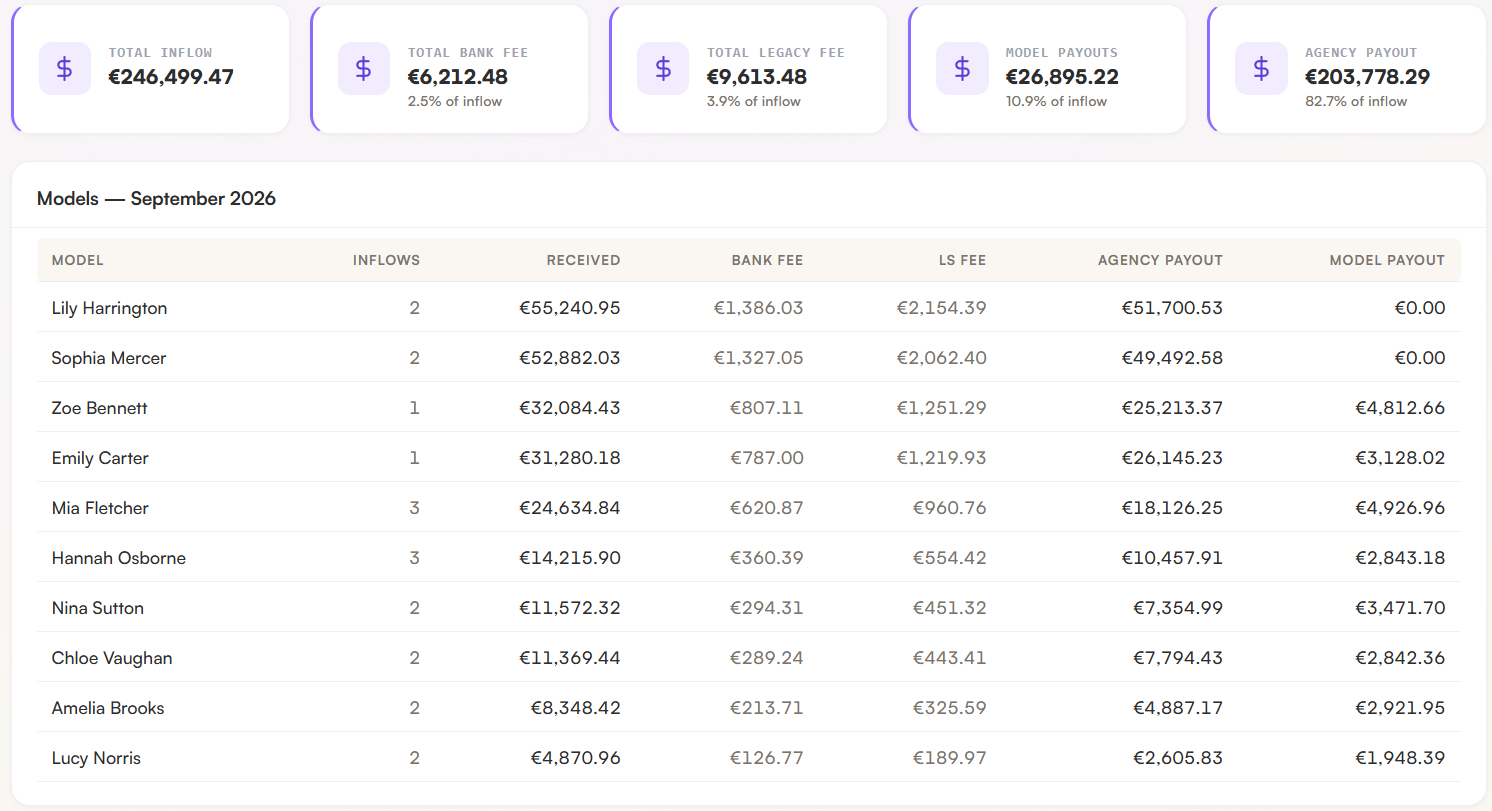
Commission only works if the numbers behind it are agreed. That means knowing which chatter closed which sale, especially when shifts overlap or several chatters work one account.
Chat-workflow tools can log sales by chatter, which beats manual shift reports. A caution applies, though: OnlyFans has no official public API, so many of these tools connect through browser extensions or other unofficial methods. Check each tool's terms and never share an OnlyFans password more widely than you need to. We cover that in how to build a systems-driven agency.
Whatever you use, write the tracking method into the chatter agreement, and let chatters see their own figures. A chatter who can check the number is far less likely to dispute it.
5. Paying chatters on time
Chatters are paid on a schedule, and the agency's cash flow decides whether that schedule holds. If a creator's transfer arrives three or four days late, chatter payroll can slip with it, which is a common way for good chatters to start looking elsewhere.
That's why the payout structure matters here. When the agency's share depends on a creator forwarding money, payroll depends on her timing too. When the split settles automatically when the payout lands, the agency knows what it has and when. We cover the Monday routine in stop writing reminders on Monday morning.
To be clear about what Legacy Solutions does: it settles the split between the agency and each creator, automatically, through a licensed banking partner. Chatter payroll still runs from the agency's own account. What changes is that it no longer waits on a transfer from a creator.
6. What to put in a chatter agreement
- The pay model: fixed, commission or base plus commission, and the amounts.
- What the commission applies to: only sales the chatter closes, or the whole page.
- Whether it's calculated on gross or net.
- Who bears the cost, and whether it comes out before or after the agency-creator split.
- How sales are tracked, and how the chatter can see her or his own figures.
- Payment frequency, the cutoff date and what happens to chargebacks on a sale already paid.
- Anything that should be reviewed by a lawyer in the chatter's country, since employment classification varies.
Frequently asked questions
What commission do OnlyFans chatters usually earn?
Published figures vary a lot, from under 1% to around 15% of sales, depending on whether base pay is included, the size of the account and what the percentage applies to. Most of those figures come from agency and recruiter blogs, so use them as a rough range and define the terms in writing.
Should chatter commission be calculated on gross or net?
Either can work, but they give different amounts, so the agreement has to say which. Calculating on net (after the platform fee) is more conservative for the agency. Gross is more generous to the chatter. What matters is that both sides read it the same way.
Who should pay the chatters, the agency or the creator?
Many agencies pay chatters out of their own share. Others deduct the cost before the split, so it's shared. Both are legitimate, but the agreement with the creator must state which, because it changes what each side receives.
What happens to a chatter's commission if a fan files a chargeback?
That depends on the agreement. A clear one says whether commission on a charged-back sale is reclaimed or adjusted in a later period, and how. It's a common gap, and it's easier to settle before it happens.