It's 9:00 AM on Monday.
Instead of opening the traffic dashboards or thinking through growth strategy for the next big creator, the day starts with a familiar low-grade dread.
Log into the banking portals and e-wallets, cross-reference them against last week's OnlyFans payout logs, open WhatsApp or Telegram, and type the same message that goes out every week:
"Hey! Hope you had an amazing weekend. Just checking if the OnlyFans payout cleared into your account yet? Let me know so I can drop the invoice over 🙏"
If that's the weekly routine, the agency isn't running on a system, it's running a manual collections operation that happens to also manage creators. Chasing revenue every seven days is a real bottleneck, it drains time, creates friction with models, and caps how far the business can actually scale.
Here's why manual follow-ups break down structurally, and what actually replaces the whole loop.
The domino effect of the Monday routine
At small scale, a few reminder texts feel harmless. As an agency grows, the Monday routine creates a chain reaction across the whole operation:
- The executive drag. When founders or senior managers are the ones chasing payments, they're pulled away from the strategic work that actually grows the business. Revenue doesn't scale while the highest-leverage people in the company are doing basic accounts receivable.
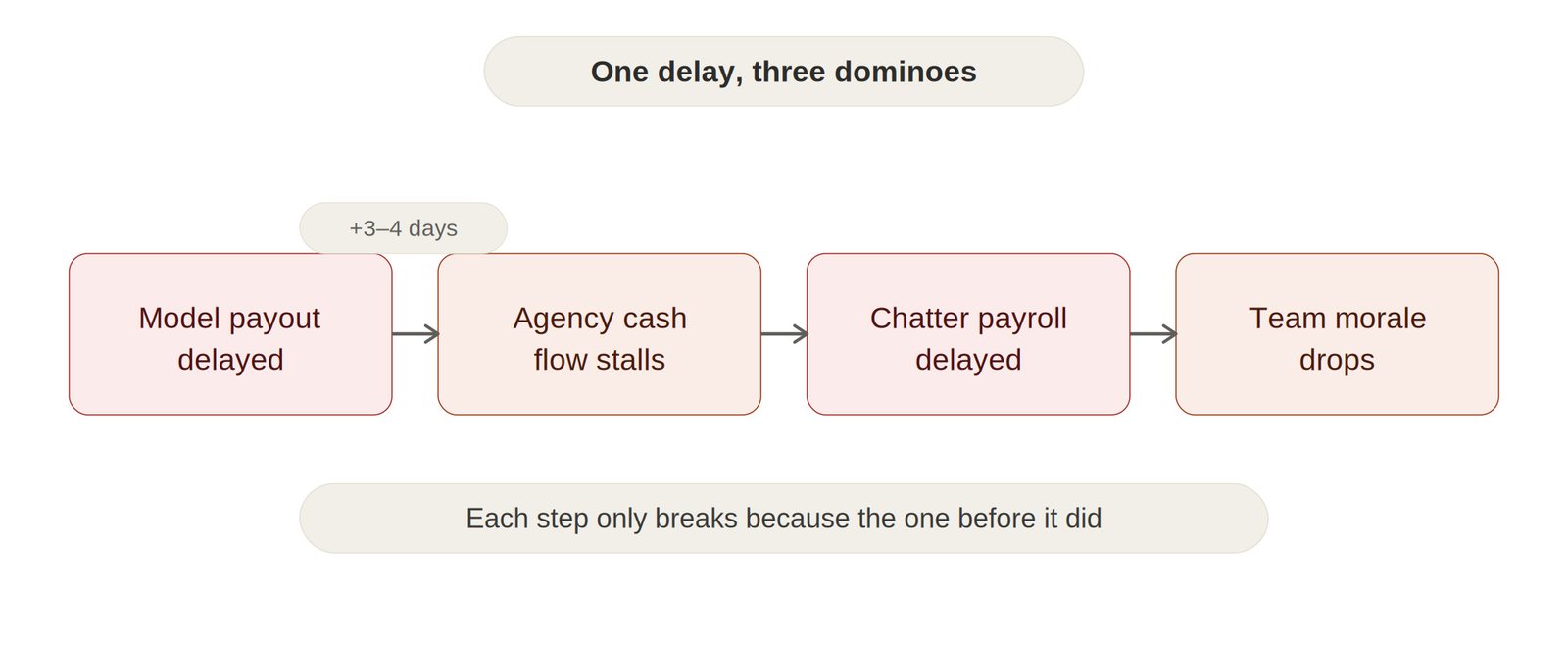
- The chatter payroll delay. A 24/7 chatting team is what drives PPV and tip revenue, and they need to be paid on schedule to stay motivated and stick around. If a model's transfer is three or four days late, agency cash flow stalls, and that delay rolls straight into chatter payroll, hurting morale and increasing turnover on the team actually generating the sales.
- The relationship erosion. Repeatedly checking in on a creator's finances changes the shape of the relationship over time. The agency stops reading as the growth partner driving her success and starts reading as a recurring expense she has to manually approve.
Why standard automation apps don't actually solve this
When agencies try to fix the bottleneck, they usually reach for tools that handle the wrong half of the problem:
- Automated invoicing software. Tools like QuickBooks or FreshBooks can auto-generate and send an invoice on schedule. That solves the sending, not the paying, the software still can't make the model log into her bank account and initiate the transfer. The invoice shows up faster. The waiting doesn't change.
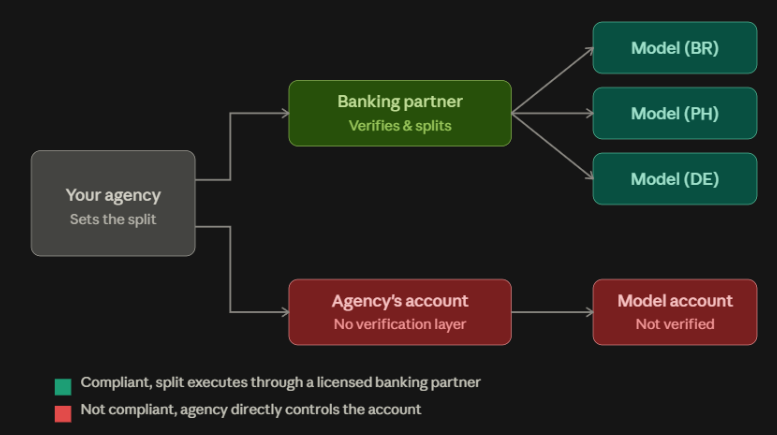
- Shared wallet workarounds. Running a neobank account or digital wallet under the model's legal name while the agency holds the login is a real compliance exposure, not a shortcut. One automated banking review or identity verification check can freeze the balance, and the agency can't complete that verification on her behalf.
Real financial automation isn't about calculating numbers faster on a screen. It's about the money itself moving at the transaction layer without anyone having to act.
The standard that actually removes the loop: closed-loop split routing
Eliminating the Monday reminder entirely means the split has to happen automatically, before either side has to think about it, not just get calculated or invoiced faster.
This is what Legacy Solutions is built around, financial infrastructure built with licensed financial institutions to automate multi-party splits at the banking layer, not a spreadsheet with a faster invoice button and not an unregulated workaround.
- Real legal compliance. The agency completes corporate verification, each model completes her own legal ID and KYC process, in line with standard banking compliance.
- Direct banking partner accounts. Each creator holds her own isolated, compliant account. Neither party holds the other's password, login, or 2FA.
- Instant, automatic settlement. The moment OnlyFans releases the week's cleared earnings, funds route through a secure banking node, the agency's percentage lands in its own corporate account, and the model's net share lands separately in hers.
What Mondays actually look like after this
Removing manual invoicing from the operation changes the day-to-day in a specific way:
- No financial back-and-forth. Nobody asks whether a payout landed, sends an invoice, or follows up on a delayed wire. The split already happened before anyone needed to ask.
- Both shares already settled. What lands in a model's account is her share, already final, nothing pending, nothing to forward. The agency's share is sitting in its own account the same way, on the same schedule, without either side waiting on the other.
- The routine doesn't change with scale. Managing 5 models or 50 looks the same on a Monday morning, open the dashboard, see the week's splits already settled.
Frequently asked questions
Can invoicing software like QuickBooks or FreshBooks fix the Monday reminder problem?
It fixes part of it, the invoice gets generated and sent automatically, but it can't make the actual transfer happen. The waiting is still there, it just starts from an automated email instead of a manual one.
What's the actual risk of running a shared wallet in a model's name to avoid invoicing?
It's a real legal and compliance exposure, the agency is operating an account it doesn't legally own, and if that account gets flagged for identity verification, the agency can't complete that step on the model's behalf. The balance can stay frozen until she does.
Does automatic settlement mean the agency has less visibility into payouts, not more?
The opposite, in a properly built setup. Both the agency and each model see the same live, reconciled numbers, the automation removes the manual transfer step, not the reporting.
How does this affect chatter payroll specifically?
Since the agency's share settles automatically on schedule rather than depending on a model's manual transfer, cash flow becomes predictable enough to pay chatters on time consistently, removing one of the more common causes of team turnover in scaling agencies.