When drafting a management contract for a new OnlyFans creator, most agency owners focus on the headline number. 50/50, 60/40, a premium 70/30 in the agency's favor. The deal gets signed, the account gets handed to the traffic and chatting teams, and everyone moves on.
Then the first large payout cycle hits, and a quiet dispute shows up. The agency calculates its cut one way. The model calculates her share a different way. The numbers don't match.
That's rarely about anyone trying to take more than they're owed. It's usually because the contract never clearly defined the actual mathematical baseline of the split, gross revenue versus net revenue. Getting that distinction wrong is a real source of tracking disputes and lost margin, and it's fixable with one precise sentence in a contract.
1. Gross vs. net, defined with real numbers
Both the agency's team and the creator need to be working from the same definition. Here's how the same $50,000 month breaks down under each one.
Gross revenue is the total amount fans spend on the profile, subscriptions, PPVs, tips, before any platform deduction.
- Fans spend $50,000 total.
- Under a 50% gross split, the agency's cut is exactly $25,000.
- The remaining $25,000 goes to the model, and she absorbs the platform's fee out of her own share.
Net revenue is what OnlyFans actually releases after its standard 20% platform fee.
- Of that same $50,000, OnlyFans takes $10,000, leaving $40,000 cleared.
- Under a 50% net split, the agency and the model split that $40,000 evenly, $20,000 each.
The exact same "50% split," written two different ways, produces a $5,000 difference in what the agency actually receives on a single $50,000 account. Across 10 or 20 models, that gap compounds into real money over a year, not because anyone did anything wrong, but because the contract never specified which number the percentage applies to.
2. Where the math gets more complicated
Beyond the base split, two recurring sources of discrepancy show up in day-to-day operations:
Chatter commissions. Most agencies pay a performance commission, typically 3-10%, to the chatters generating direct sales. If the contract doesn't specify whether that commission comes out of the gross sale or the net platform payout, the agency's own internal accounting will drift out of sync with what the model sees, even when everyone's acting in good faith.
Chargebacks. When a fan disputes a charge, OnlyFans claws that amount back from the account balance directly. On a manual setup, a model will reasonably ask why her weekly payout came in lower than what the dashboard showed earlier in the week, and resolving that usually means a manager manually reconstructing what happened.
Running this by spreadsheet means regularly reverse-engineering OnlyFans' own reporting to figure out who's actually owed what, which is a real drain on time and a source of unnecessary tension with creators who have no way to see the same numbers the agency is looking at.
3. Reconciling it automatically at the banking layer
Scaling past a handful of models without constant disputes over decimals means establishing one source of truth both sides can see, rather than two separate sets of numbers that have to be reconciled by hand after the fact.
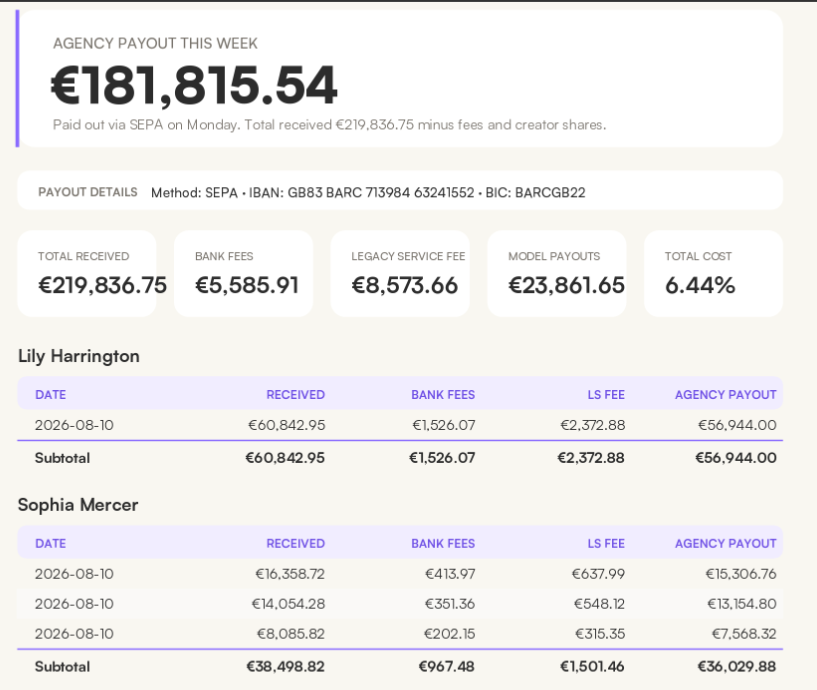
This is what Legacy Solutions is built around, financial infrastructure built with licensed banking partners to execute contract-defined math directly at the transaction layer, not a tracking spreadsheet with better formulas.
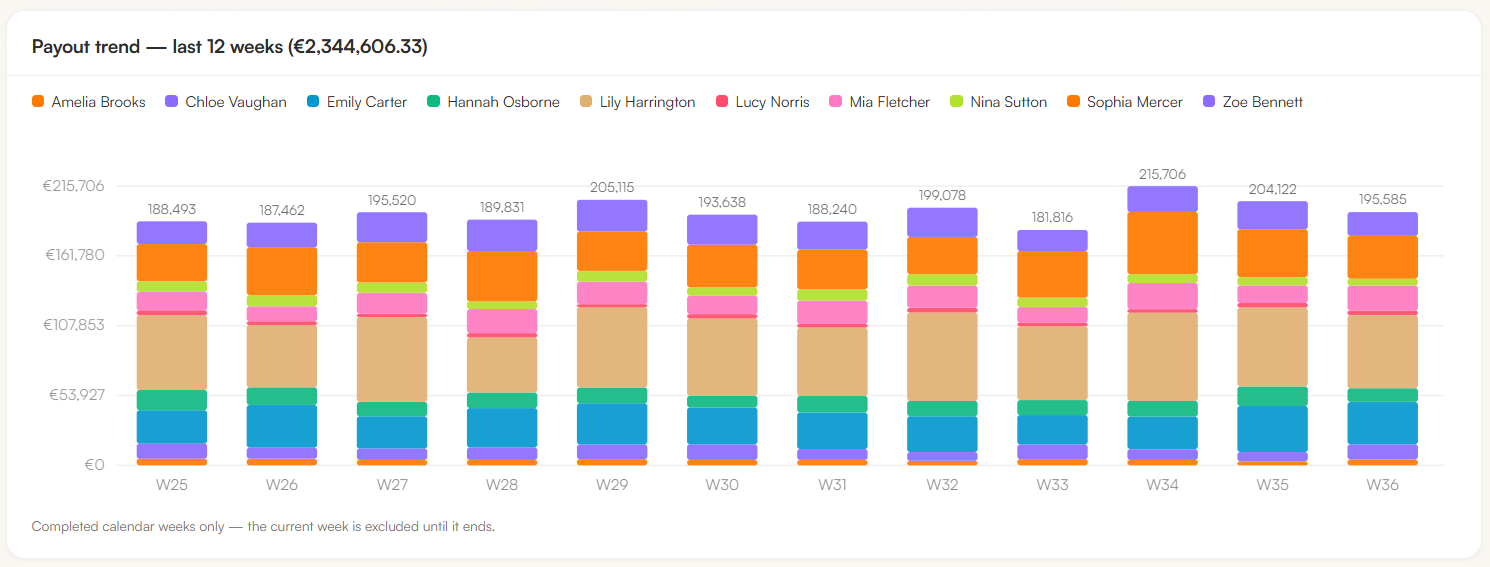
- Contract rules encoded during onboarding. Both the agency and each creator complete formal KYC and identity verification, and the exact contract terms, gross or net, chatter commission handling, are configured into the system from the start.
- Automatic math at the banking node. The moment OnlyFans releases the weekly cleared payout, the platform fee, any chargebacks, and chatter commissions are all accounted for automatically, and the agency's exact contracted share routes to its own account.
- One shared, reconciled view. The agency and the creator each log into their own portal and see the same live, bank-reconciled numbers, removing the need to reverse-engineer a dispute after the fact.
Frequently asked questions
Is a gross split or a net split better for an agency?
Neither is inherently better, they're different baselines that produce different actual dollar amounts for the same stated percentage. What matters is that the contract specifies which one applies, so both sides are calculating from the same number.
How should chatter commissions be defined in a contract to avoid disputes?
Explicitly, stating whether the commission is calculated on the gross sale amount or the net amount after the platform fee, in the same clause that defines the agency-model split itself.
Does a chargeback affect the agency's share, the model's share, or both?
This depends entirely on how the contract defines it, and it's a common gap in agency-creator agreements. A clear contract specifies how a chargeback clawback is allocated between the two parties, rather than leaving it to be negotiated after it happens.
Can automated reconciliation work with an existing gross-split contract, or does the contract need to change first?
It can work with either gross or net contracts, the system applies whatever baseline the contract specifies. What matters is that the contract itself is unambiguous about which one applies, since the automation only removes the manual calculation step, it doesn't resolve an underlying ambiguity in the contract's wording.