
When you're first starting an OnlyFans management agency, trust is your primary currency.
You build close relationships with your first few creators. You talk daily on Telegram, celebrate revenue milestones together, operate more like a tight-knit team than a company. The weekly payout lands, you send a manual invoice, and she transfers the management fee within a few hours. It feels clean and personal.
Past the 6- and 7-figure mark, the operational landscape shifts.
The agencies operating at that scale don't run this way anymore, not because they trust their creators less, but because they've run into a specific, structural fact: trust is real and valuable in a working relationship, and it's a poor foundation for financial infrastructure that has to hold up every single week regardless of how anyone's feeling that day.
Here's why agencies scaling past seven figures move off manual invoicing, and what they run instead.
The scaling breakpoint
Going from 3 models to 30 doesn't just add more of the same admin work, it creates a ceiling that's easy to miss until you hit it.
Lost operational time. A large agency can't have its senior team spending every Monday tracking down transfers, checking bank screenshots, or manually adjusting for platform chargebacks. Every hour spent chasing a payout is an hour not spent on traffic, strategy, or the accounts that actually drive growth.
The success-resentment multiplier. A model earning $3,000 a month pays a $900 invoice without much friction. That same model at $100,000 a month, sending a manual wire for $40,000 or $50,000 every cycle, runs into real psychological resistance, not because she's less loyal, but because a large lump sum landing fully in her own possession changes how that transfer feels, for anyone.
Fragmented international capital. Agencies operating across borders, a model in Europe, a chatting team in the Philippines, corporate registration in the US, run into real friction when payments depend on manually routed international wires or fluctuating e-wallet limits. That friction shows up as delays and as leakage through conversion fees.
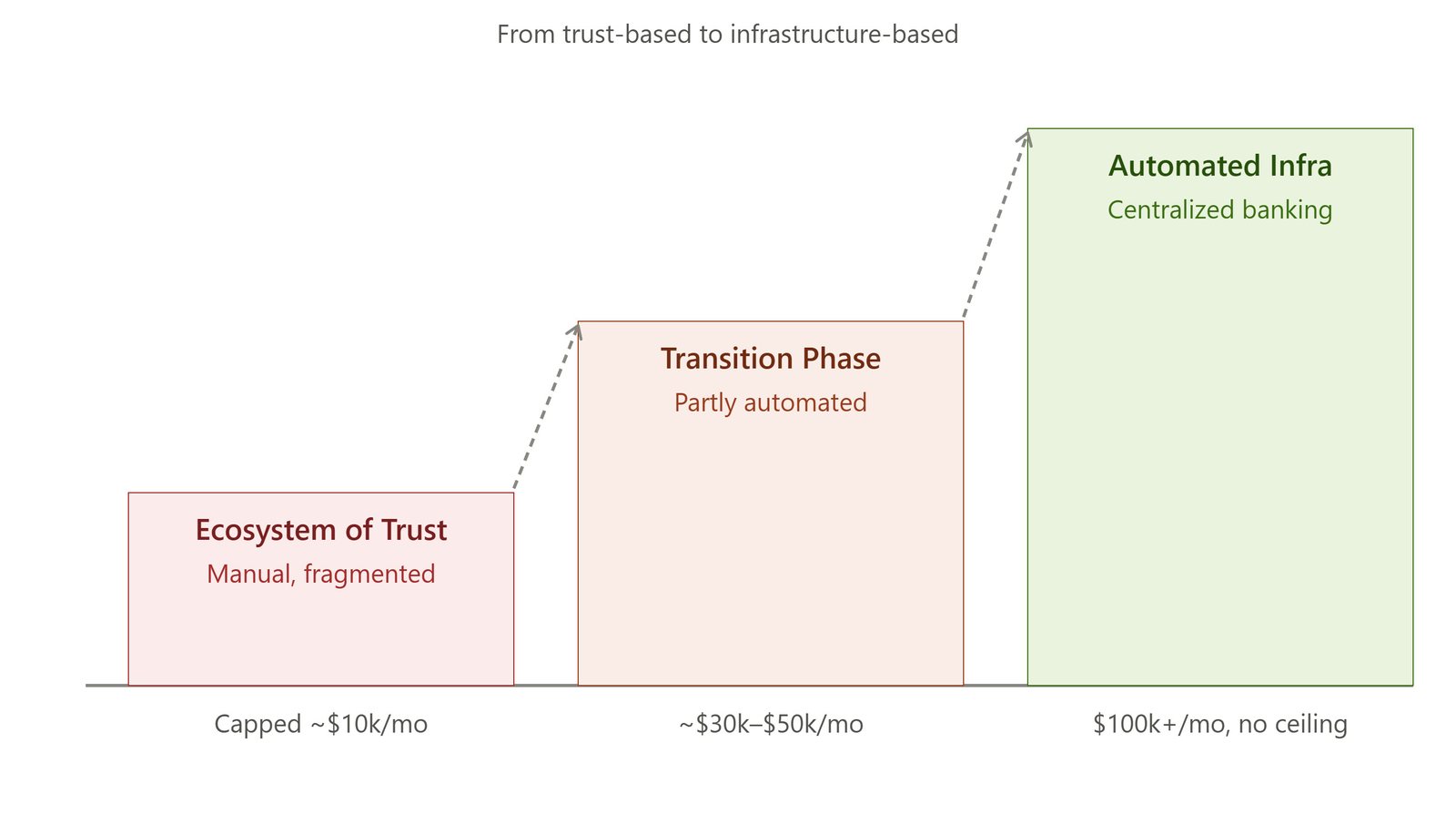
Moving from people to systems
Look at any enterprise-level business outside this industry, an advertising agency, a franchise network, a software platform, none of them run their primary revenue splits on a handshake-and-invoice basis. They use closed-loop, automated settlement.
Agencies scaling past seven figures apply that same standard to their own cash flow. They separate financial execution from anyone's day-to-day choice to act.
Removing the decision to pay from the weekly routine removes the friction with it. The relationship with the creator stays clean, because money isn't a recurring, uncomfortable conversation. The agency stays positioned as the growth partner driving her income, not the one showing up every Monday to collect from her.
The institutional blueprint: bank-grade revenue splits
Scaling past seven figures without building an expensive back-office team means the financial system has to calculate and pay out automatically, at the banking layer, not just faster on a spreadsheet.
This is what Legacy Solutions is built around, not a surface-level tracking app, and not an unverified workaround, financial infrastructure built alongside licensed institutions to automate revenue splits at the banking layer.
- Real institutional onboarding. The agency goes through corporate verification, and each model completes her own legal identification and KYC process, in line with standard international banking compliance.
- Automated settlement. The moment OnlyFans releases the cleared balance, funds route through a compliant banking node on the agency's normal weekly cycle.
- Direct, separate routing. The split executes based on the agreed contract terms, the agency's fee lands in its own corporate account, the model's net share lands separately in hers.
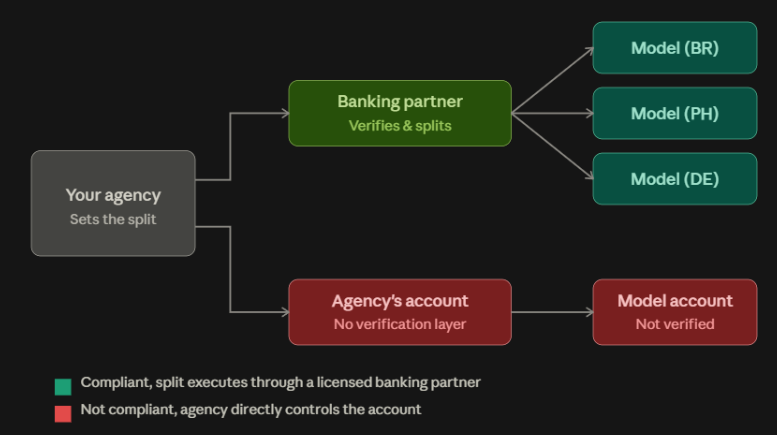
No manual invoice goes out, because there's nothing pending to chase, both shares were already final the moment the payout landed. That's what actually keeps the relationship clean, not that the model doesn't notice her earnings, but that there's no leftover step where either side has to ask the other for anything.
Build the agency like an enterprise
An agency built to be a real, valuable, sellable asset can't run its core financial engine on spreadsheets and good intentions indefinitely. It needs systems that hold up whether or not anyone's checking messages that day.
Protecting margins and removing operational bottlenecks isn't really about the invoicing itself, it's about building the kind of infrastructure a buyer, a partner, or a bank would actually trust when they look under the hood.
Frequently asked questions
At what revenue point does manual invoicing typically become unmanageable?
There's no fixed number, but agencies commonly feel it around the point where a handful of models scale into six figures combined, or where model count crosses into the 15-30 range, whichever comes first for that specific agency's structure.
Does moving to automated settlement change the underlying commission agreement?
No. It changes how an already-agreed split gets executed, not the percentage or the terms themselves. The contract still defines what's owed, the infrastructure just makes sure it settles automatically instead of depending on a manual transfer.
Is it harder to move to automated infrastructure once an agency is already at scale?
It's more involved simply because there are more models and more relationships to onboard at once, but the underlying process, verifying the agency, verifying each model, confirming the agreed split, is the same regardless of when an agency makes the switch.
How does this affect international payments specifically?
A properly built automated split handles currency conversion and per-country verification as part of the same process, rather than leaving an agency to manually