
An agency with models in three countries doesn't have one payout problem, it has three, plus a fourth one for itself. Here's what actually makes a cross-border split safe, and what quietly makes it risky.
Why international splits are riskier than domestic ones
Splitting commission with a model in your own country is already a solved operational problem, or at least a well understood one. Splitting with a model in a different country adds three things that don't exist domestically: currency conversion, a second country's banking rules, and identity verification requirements that vary depending on where she's a resident.
None of that is exotic. It's the same reason any business paying international contractors deals with more friction than one paying domestic employees. What's specific to this industry is that agencies often try to solve it with tools built for something else entirely, consumer money transfer apps, personal e-wallets, or informal arrangements, none of which were designed to handle recurring, verifiable business payouts across borders.
The common ways agencies currently handle this, and why they're risky
- Sending the model's share via Wise, Revolut, or similar consumer apps. Why agencies use it: fast, familiar, low upfront setup. The actual risk: not built for recurring business volume, accounts get flagged or limited as pattern volume grows.
- Paying through a personal e-wallet in the model's name, managed by the agency. Why agencies use it: feels simpler than setting up formal banking per country. The actual risk: the agency is operating an account it doesn't legally control, a real legal exposure regardless of country.
- Converting currency manually, then wiring the remainder. Why agencies use it: avoids a formal multi-currency setup. The actual risk: conversion spreads are opaque, and manual wires add days of delay with no audit trail.
Each of these solves the immediate problem (the model gets paid) while creating a slower one (the setup doesn't hold up as volume or model count grows, and it leaves the agency with no clean documentation if a bank ever asks questions).
What actually makes a cross-border split safe
Safety here isn't about finding a clever workaround for each country, it's about removing the informal steps entirely. A safe setup for international splits generally has three properties:
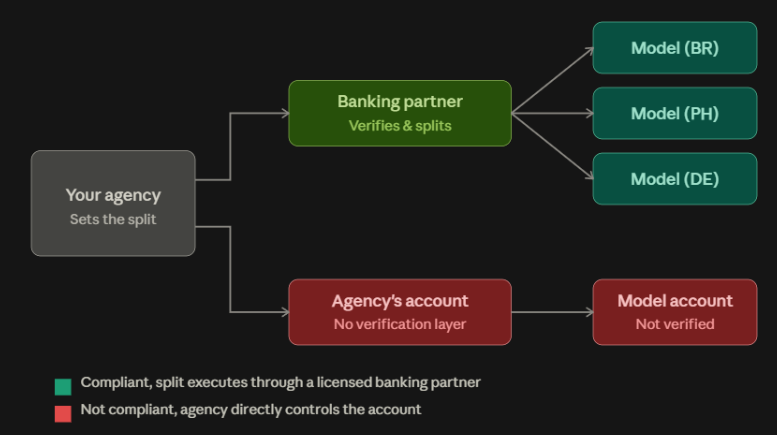
- Each model is the verified owner of her own account. Not an account the agency operates on her behalf, regardless of how that arrangement started.
- The split executes automatically, in the correct currency, without a manual conversion step. Manual conversion is where both errors and hidden costs happen.
- Every payout is documented the same way, regardless of which country the model is in. One inconsistent record per country is how agencies end up unable to answer a bank's or accountant's questions later.
Currency conversion and where agencies actually lose money
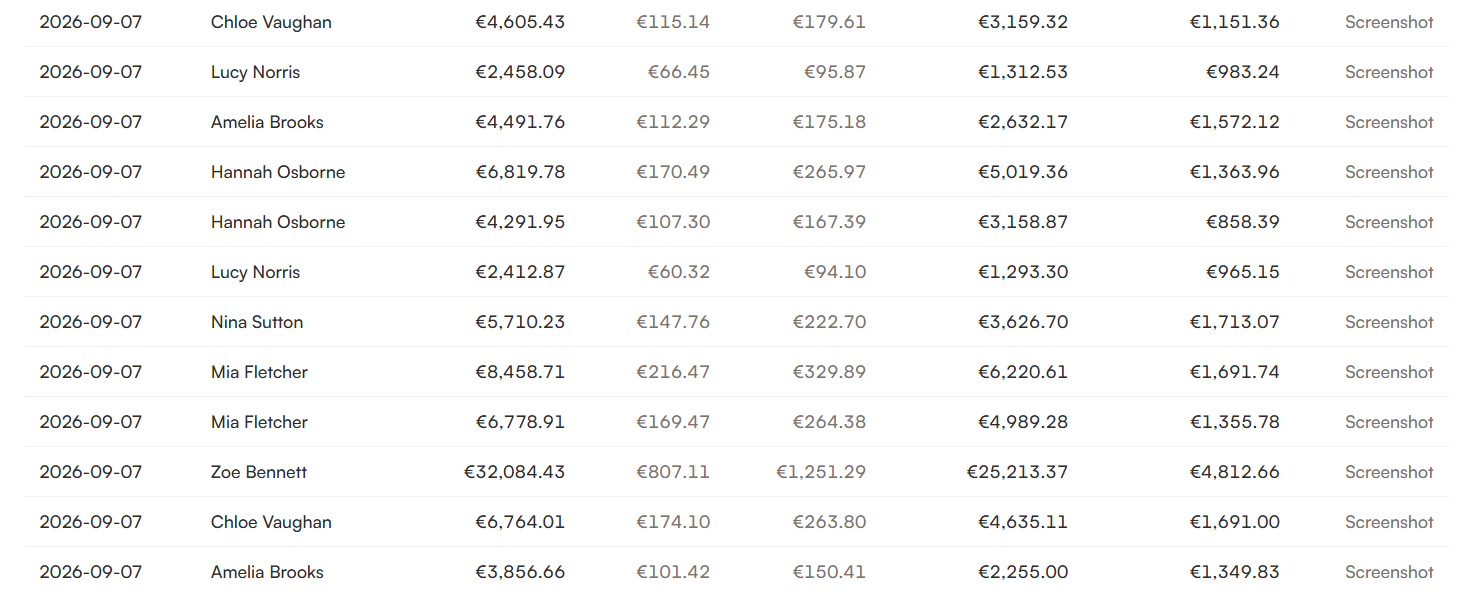
Currency conversion is where a lot of the real cost hides. A wide conversion spread, the gap between the real exchange rate and the rate an agency or model actually receives, can quietly cost more than any platform fee. This is usually invisible unless it's explicitly disclosed, which is one of the reasons transparent, itemized fee reporting matters more for international splits than domestic ones: it's the only way to actually see whether conversion is eating into what a model is supposed to receive.
The safest setups convert once, at a disclosed rate, as part of the automatic split, rather than leaving conversion as a manual step an agency handles inconsistently model by model.
Compliance considerations when paying models abroad
International payouts involve identity verification (KYC) and anti-money-laundering checks that apply per individual, based on her country of residence, not the agency's country. This isn't unique to this industry, it's standard for any cross-border payment relationship. A few things worth knowing:
- A model's local banking regulations may affect what documentation she needs to provide before receiving payouts, and this can vary meaningfully by country.
- Some countries and individuals are subject to financial sanctions, which legitimate banking partners are legally required to screen for. This isn't something an agency can or should try to work around, and a licensed partner will simply decline to onboard someone who doesn't clear this screening.
- Tax withholding and reporting obligations differ by country and are ultimately each model's and each agency's own responsibility to understand. Nothing here should be read as tax advice, an accountant familiar with the relevant jurisdictions is the right resource for that specific question.
How a licensed banking partner handles international splits
The same principle that makes domestic splits safe, each model holding her own dedicated account, with the split executed automatically by a licensed banking partner rather than the agency, applies across borders too. The difference internationally is that the banking partner also handles the parts an agency shouldn't be handling itself: verifying each model's identity against her own country's requirements, screening for sanctions compliance, and converting currency at a disclosed rate as part of the automatic split.
The agency's software layer sits on top of that, the same way it does domestically: defining the split percentage, giving both the agency and each model a live view of what's been paid, and producing the same standardized documentation regardless of which country a given model is in.
What to ask before choosing an international payout setup
Before committing to a setup for paying models across multiple countries, the questions worth asking are:
- Which countries does the banking partner actually support, and is that confirmed in writing rather than assumed?
- Who performs identity verification and sanctions screening, the platform's licensed partner, or is that left to the agency?
- Is the currency conversion rate disclosed as part of every payout, or bundled invisibly into the amount received?
- Does documentation look the same across every model, regardless of country, or does it vary depending on how that particular payout was handled?
Frequently asked questions
Is it legal to pay models in different countries through one agency setup?
Yes, provided each model's payout runs through a properly verified account and the banking partner handling the split is licensed to operate in the relevant countries. The legal risk isn't in paying internationally, it's in trying to route those payments through accounts or arrangements that skip verification.
Does currency conversion happen automatically, or does the agency need to handle it manually?
In a properly built setup, conversion happens automatically as part of the split, at a disclosed rate. Manual conversion is usually a sign the underlying payout setup wasn't built for international use in the first place.
Can an agency pay a model in a country subject to financial sanctions?
No, and no legitimate banking partner will process it. This isn't a policy choice a platform makes, it's a legal requirement any licensed financial institution has to follow, and it applies regardless of which payout provider an agency uses.
Does every model need to submit the same verification documents regardless of country?
Not exactly, requirements can vary by country based on local regulations, but the standard being applied, proper identity verification before payouts begin, should be consistent even when the specific documents differ.