Agencies usually pick one of two setups, and both create a version of the same problem. Here's why the real question isn't which account the money should land in first.
The short answer
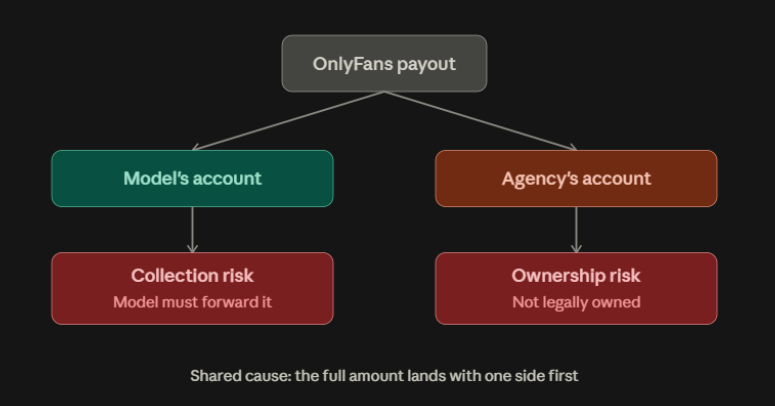
Neither, ideally. Routing the full payout to the model's account and invoicing for the agency's cut creates a collection problem. Routing it to the agency's account and paying the model a fixed amount creates a legal and scalability problem. The setup that avoids both is one where neither party receives the full amount first: each model has her own dedicated account, and the agreed split executes automatically before the money is fully "with" either side.
That answer needs unpacking, because most agencies are choosing between the two flawed options without realizing there's a third.
Option 1: payout goes to the model's account
This is the standard setup for percentage-split arrangements (70/30, 80/20, and similar). The model's OnlyFans revenue lands in her own personal account, and the agency invoices her for its agreed share afterward.
The appeal is obvious: it's simple, and it clearly respects that the revenue is legally hers first. The problem is what happens next. The agency's commission depends entirely on the model choosing to send it, on time, in full. At small scale this works because trust is high and volume is low. Past a handful of models, it becomes a recurring collections exercise, and every late or partial payment is a direct hit to agency revenue with no real recourse beyond the relationship itself.
Option 2: payout goes to the agency's account
This is common in salary-style or 100/0 arrangements, where the agency pays the model a fixed amount regardless of what she earns that period. To make this work, agencies often set up the OnlyFans payout method, or a connected e-wallet, in the model's name, but operate it themselves.
This solves the collection problem, the agency already has the money, but it creates a more serious one. Operating a financial account that isn't legally the agency's, even with the model's informal agreement, is a real legal exposure, not a gray area. It also doesn't scale cleanly: at meaningful volume, e-wallets and payout methods built for individual use start hitting limits, holds, and freezes that have nothing to do with anyone's business practices and everything to do with the tool being used outside its intended purpose.
- Payout to model's account, agency invoices after. What breaks: collection depends on the model forwarding funds. Who bears the risk: the agency, in lost or late commission.
- Payout to agency's account, model paid a fixed amount. What breaks: the agency is operating an account it doesn't legally own. Who bears the risk: the agency, in legal exposure, and both parties if the account is frozen.
Why both traditional options create risk
Both setups share a root cause: the full payout lands with one party, and the other party's share depends on a second, separate action happening correctly afterward. Whether that second action is "the model forwards the commission" or "the agency remembers to pay the model her fixed amount," it's a manual step sitting between the money arriving and the money being where it's supposed to be. Manual steps are where errors, delays, and disputes come from, regardless of which direction the money is flowing.
The legal line: ownership matters more than who receives funds first
The question "should the payout go to the agency or the model" is actually a proxy for a more specific one: who legally owns and controls the account the money lands in? That's the detail that determines legal exposure, not which party's name is more prominently associated with the business.
A model receiving her full payout into her own account, which she controls, is not a legal problem, even if it creates a collection headache for the agency. An agency operating an account nominally in a model's name, but controlling access and withdrawals itself, is a legal problem, regardless of how the arrangement was agreed informally between the two parties.
The third option: neither account receives the full amount
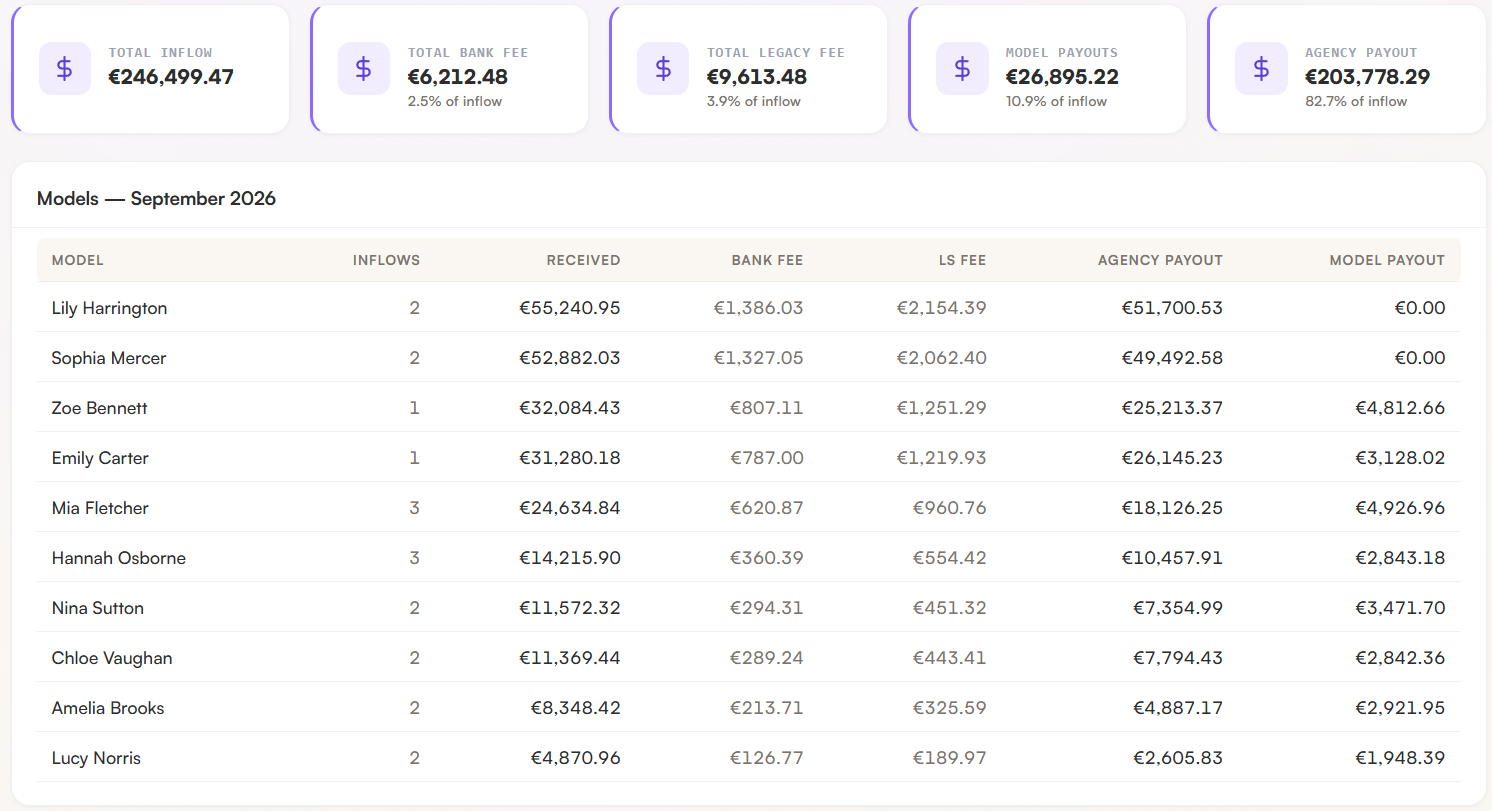
The setup that avoids both problems doesn't route the full payout to either party first. Instead, each model holds her own dedicated account, verified and controlled by her, at a licensed banking partner. Revenue lands there, and the agreed split, the agency's percentage and the model's percentage, executes automatically the moment it arrives.
This resolves both failure points at once. The agency isn't waiting on an invoice, because its share is already calculated and paid out as its own separate amount, not something the model has to remember to forward. The agency also isn't operating anyone else's account, because it never held custody of the model's share in the first place, the banking partner did, executing a split both parties agreed to in advance.
How to decide what's right for your agency
For an agency still choosing between the two traditional setups, a few questions clarify which risk matters more right now:
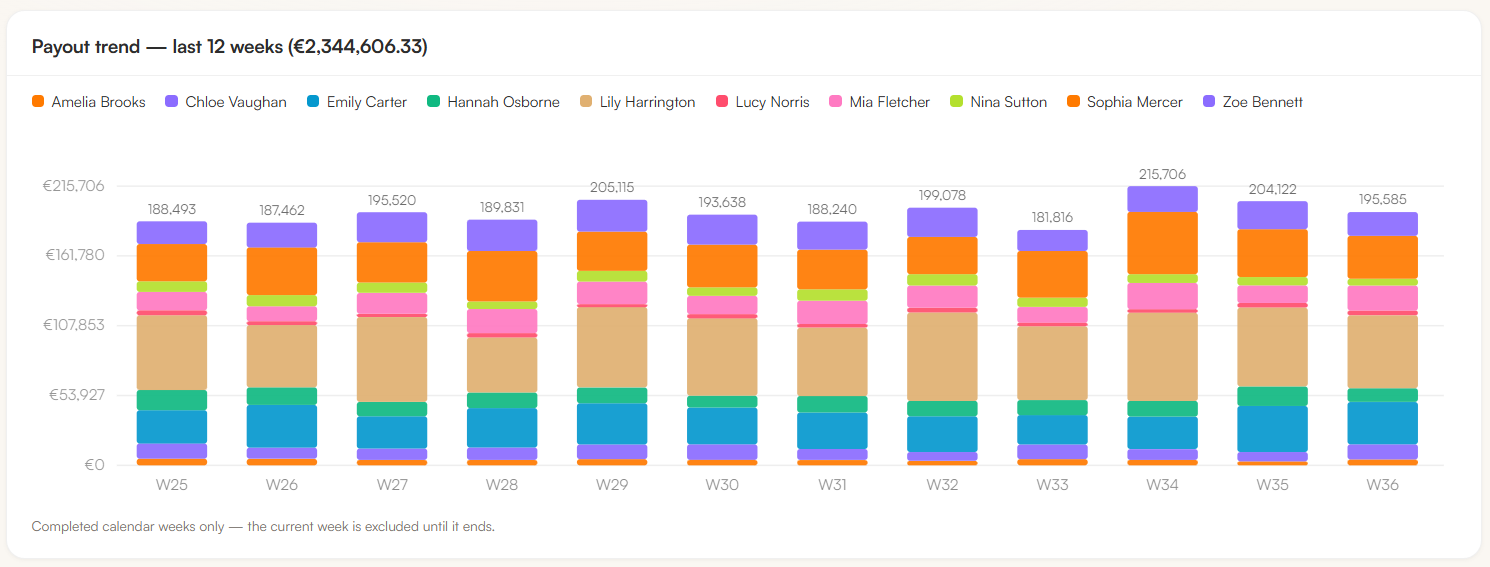
- How many models are you managing? Below 5, manual invoicing is annoying but survivable. Above that, it becomes a real operational cost.
- Are you currently operating any account that isn't legally yours? If so, that's the higher-priority risk to resolve, regardless of how well it's currently working day to day.
- Could you produce a clean, reconciled record of every split if a bank or accountant asked tomorrow? If not, neither traditional setup is actually documenting itself well enough, independent of which account the money starts in.
In most cases, the honest answer is that the question itself, agency account or model account, is worth replacing with a setup where that choice doesn't have to be made at all.
Frequently asked questions
Is it illegal for an agency to receive the full OnlyFans payout directly?
Not inherently, if the account receiving it is legally the agency's own account and the model is paid her share separately as agreed. The legal risk isn't which party receives funds first, it's whether an account is being operated by someone other than its legal owner.
Is it safer for the model to always receive the payout first?
It removes the legal exposure around account ownership, but it shifts the risk to the agency in the form of commission collection, which is a real operational cost, just not a legal one.
Can the commission split happen without either party holding the full amount first?
Yes, when each model has her own dedicated account and the split executes automatically at the banking level. Both the agency's share and the model's share are calculated and paid out separately from the same incoming payout.
What's the actual legal risk of running a model's e-wallet for her?
Operating an account that isn't legally yours, even with the account holder's informal agreement, is a genuine legal exposure, and it also tends to hit practical limits (holds, freezes, transaction caps) as volume grows, independent of the legal question.