It's the notification every OnlyFans agency owner dreads on a Monday afternoon.
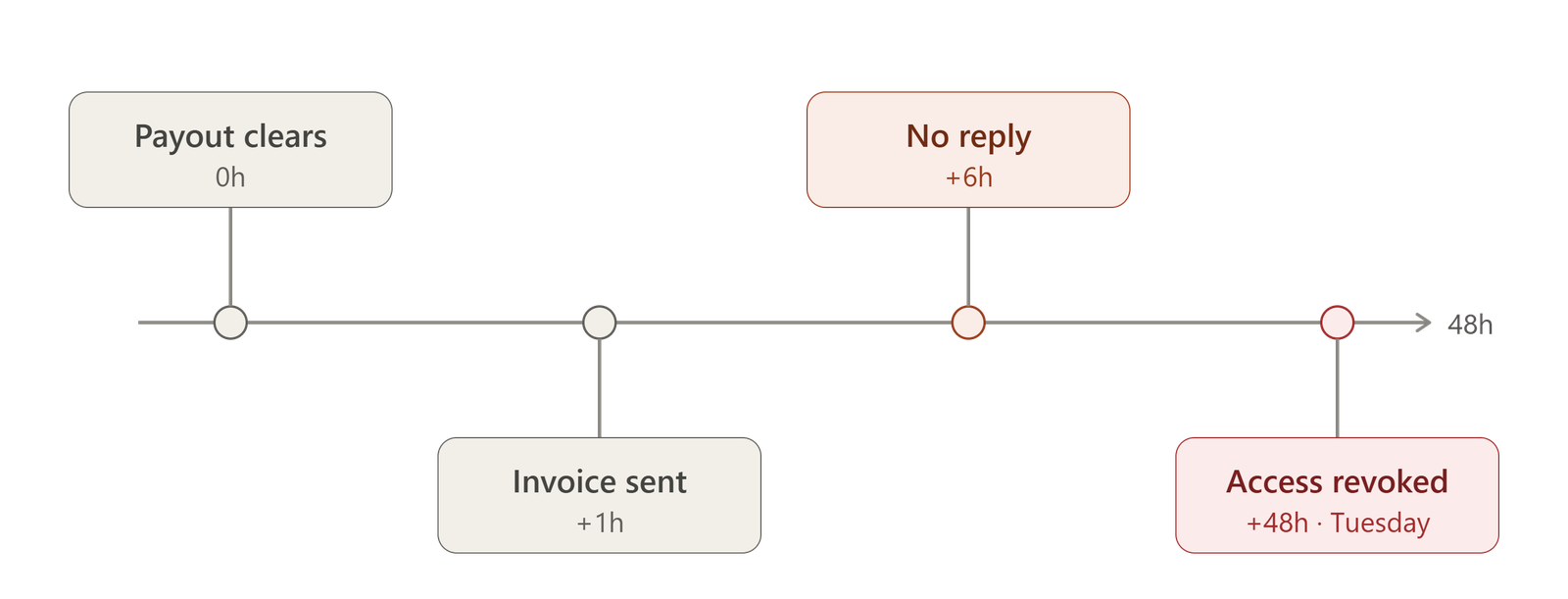
The payout cleared 48 hours ago. The dashboard shows $32,000 hit the model's linked account. The weekly invoice goes out for the agency's 40% management share, $12,800.
An hour passes. Read receipts are on. No reply.
Six hours pass. A polite follow-up goes out.
By Tuesday, the account managers notice they've been removed from the creator's personal Telegram. The OnlyFans profile password has been changed.
That's a ghosting, and it isn't bad luck. It's what happens when an agency's revenue depends on manual invoicing. Here's why it happens, why the standard recovery playbook doesn't work, and what actually closes the exposure window.
Why this happens
It's tempting to read a ghosting as a character problem. Usually it isn't, it's a structural one, and it tends to show up right when scaling is working.
When an agency takes a creator from $3,000 a month to $50,000+, her financial life changes fast, sudden wealth brings sudden pressure: a large purchase, a family request, a tax bill nobody planned for, advice from someone outside the agency. None of that is unusual, it's what happens to most people who go through a fast income jump.
The structural problem sits underneath all of that: a large weekly lump sum lands in her personal account first, in full, before any split happens. She's looking at the gross number in her own account. When the invoice for $10,000 or $15,000 arrives days later, it isn't landing on neutral ground, it's competing against whatever financial pressure she's already under that week. The agency's fair, contractually-agreed share starts to look like a decision she gets to make in the moment, rather than something already settled.
Why the standard recovery playbook falls short
Once a ghosting happens, agencies usually reach for the same three tools, and all three run into the same wall.
- The contract threat. A cease-and-desist or the threat of legal action, technically valid, practically slow. Pursuing this across state or international lines takes months, real upfront legal cost, and no guarantee of recovery if the funds are already spent by the time it reaches a courtroom.
- The platform report. Reporting the account to OnlyFans as a breach or theft doesn't get traction, their terms are explicit that they don't mediate financial disputes between a creator and a third-party management company.
- The account seizure attempt. Logging in and trying to redirect payout details to the agency's own banking information is worse than doing nothing, it's a serious compliance trap. Automated KYC systems flag a name mismatch on payout destination immediately, which risks a permanent account ban and forfeiture of any pending balance, for the model and the agency both.
All three share the same root problem: they're recovery attempts after the money has already landed somewhere the agency doesn't control. By the time any of them are needed, the leverage is already gone. The only setup that actually prevents this is one where the lump sum never lands unsplit in the first place.
From loose trust to infrastructure that doesn't depend on a reply
An agency scaling toward six or seven figures can't run its financials on promises, goodwill, or hoping a Monday message gets answered. What's needed is a system where the split doesn't depend on anyone's choice to pay or not pay, because there's no point where that choice exists.
That's what Legacy Solutions is built around, not a tracking spreadsheet with extra steps, and not a grey-market workaround, a compliant infrastructure layer that executes the revenue split at the banking level, before funds ever reach the model's personal account as one undivided amount.
- Real identity verification. Corporate verification for the agency, and a full legal ID and KYC process for each model, aligned with standard international financial compliance practices.
- Automated settlement. Every payout cycle, when OnlyFans releases the cleared balance, funds route through a licensed banking partner automatically, on the agency's normal schedule.
- Both shares settle separately, at the same moment. The agency's fee lands in its own business account. The model's share lands in hers. Neither side is waiting on the other to act.
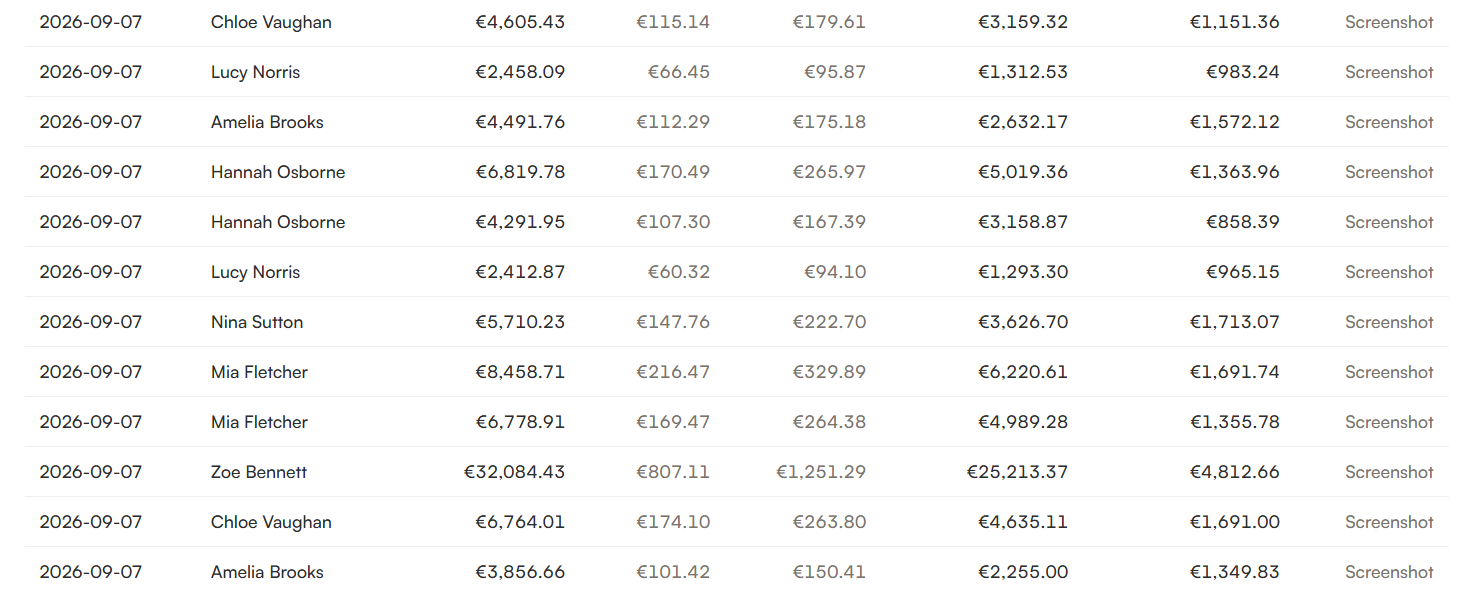
There's no giant gross sum sitting in her account for days with an invoice arriving after the fact to claim a piece of it. Both amounts are already final by the time either side is looking at a balance. That's what actually removes the incentive to go quiet, not that she doesn't see her earnings, but that there's nothing left pending that either side has to chase, negotiate, or resent.
Frequently asked questions
Is ghosting after a payout usually deliberate, or does it happen for other reasons?
It's rarely planned from the start. It's much more often a structural response to financial pressure meeting a large, undivided lump sum, the kind of pressure that shows up after fast income growth. The fix is removing the structural gap, not assuming bad intent.
Can an agency legally redirect a model's payout to itself if she stops responding?
No, and attempting it is a serious compliance risk on its own. Automated KYC checks flag a name mismatch on payout destination immediately, which can result in a permanent account ban and loss of pending balance for both parties, independent of whatever dispute triggered it.
Does OnlyFans mediate payment disputes between an agency and a model?
No. Their terms are explicit that financial and operational disputes between a creator and a third-party management company aren't something the platform arbitrates.
How is this different from just having a stronger contract?
A contract establishes what's owed and gives legal recourse after something goes wrong, it doesn't move money or prevent the gap from opening in the first place. Automated splitting removes the gap itself, the contract becomes a backstop for genuine disputes instead of the only thing standing between an agency and its commission. See the companion piece on [contract enforcement](/blog/how-do-you-legally-and-operationally-enforce-a-revenue-split-contract) for how the two work together.