Every OnlyFans management agency starts with the same goal: find a talented creator, optimize her page, scale the traffic, and watch the revenue climb.
You invest weeks of unbilled setup hours, run paid acquisition funnels, and hire a dedicated chatting team to cover 24/7 shifts. Then the breakthrough happens. The model scales from making $2,000 a month to clearing $50,000 a month.
It feels like winning. What's actually happened is you've stepped into the biggest operational trap in this industry: the more successful your top model becomes, the higher your agency's financial risk climbs, not lower. Here's the anatomy of that trap, why manual systems don't fix it, and what actually does.
Where the resentment actually comes from
When a model is earning $3,000 a month on a 70/30 split, sending a $900 invoice for the agency's share feels completely reasonable. It's a small, manageable fraction of her livelihood.
Now look at what happens when that same model scales to $60,000 a month:
- The full payout lands first. Every week, OnlyFans deposits the cleared funds directly into the model's personal account, mandated by the platform's own KYC rules, the payout account name has to match the model's legal ID.
- The numbers get bigger, not just proportionally. At $60,000 a month, the weekly deposit is $15,000. Under an 80/20 or 70/30 split, the agency's share of that single deposit is $10,500 to $12,000.
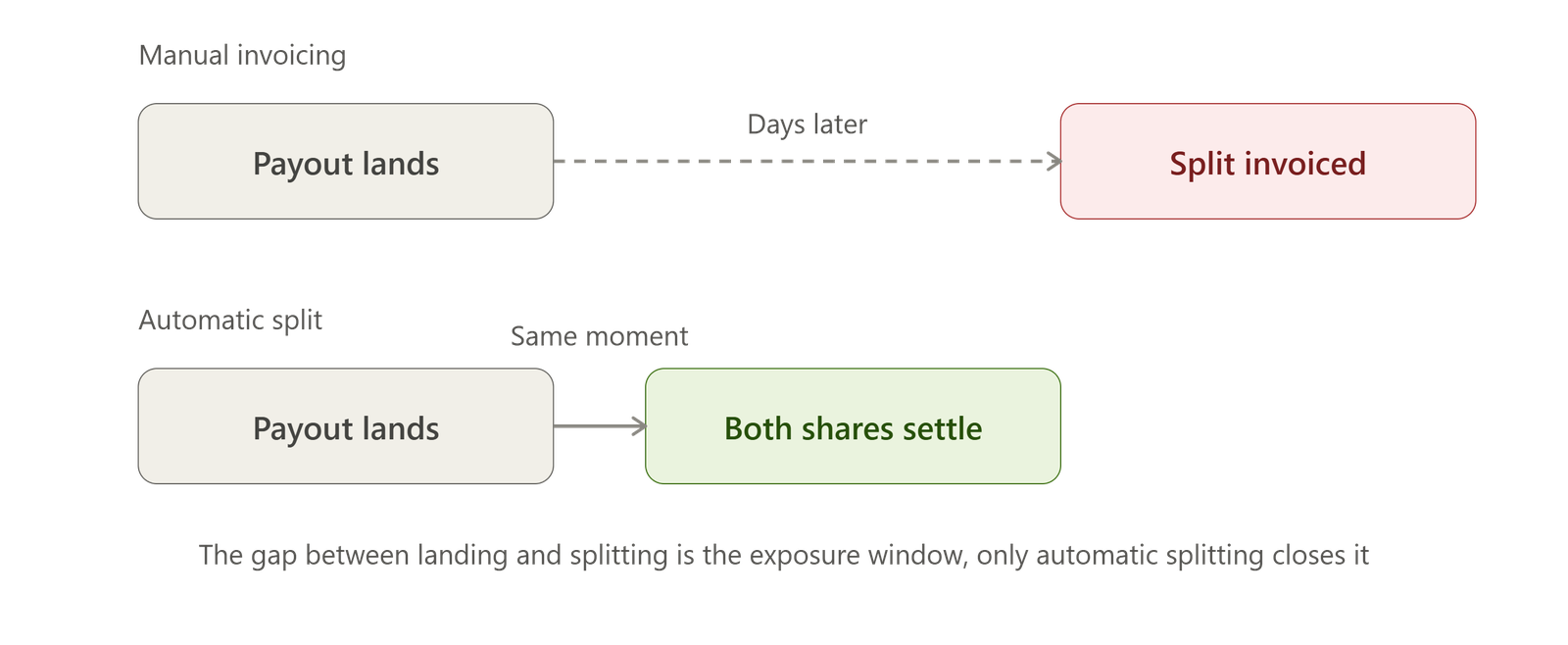
- The structure creates the resentment, not the person. The model doesn't see "her $3,000." She sees $15,000 land in an account that's legally and practically hers, then watches a chunk of it get invoiced away. That's not a trust problem specific to any one model, it's what happens whenever a large amount lands with one party before a second, separate step divides it. The bigger the numbers, the more that forwarded amount starts to feel like a loss instead of an agreement being honored.
This is the same dynamic covered in more detail in how automated commission collection actually works, just visible at a scale where it can't be ignored anymore.
Three risks that show up once this starts
The renegotiation pressure. "Why am I giving you 30%? It's my face, my content, my page." There's usually a lower-cut agency in her DMs already. The moment she's holding 100% of the cash and deciding what to forward, the contract becomes a starting point for negotiation, not a fixed term.
The missed payout. It only takes one bad month, an unexpected expense, a bad piece of advice, a change of plans, for a model to receive a payout and not forward the agency's share on schedule. A single $20,000 payout cycle that doesn't get split correctly can represent months of agency margin, gone in one missed transfer, not because anyone necessarily intended harm, but because the structure made it possible.
The grey-market freeze. To get around invoicing, some agencies set up e-wallets, Revolut, Skrill, multi-currency Wise accounts, in the model's name but controlled by the agency. This isn't a workaround, it's a live legal exposure. The moment a compliance check triggers identity verification or a residency audit, the account gets frozen, and the agency's capital is sitting inside a financial structure it never legally owned.
Why "asking nicely" isn't an enterprise system
If the Monday morning routine involves manual invoice reminders, tracking bank transfers by hand, or messaging a creator to ask whether last week's payout cleared, that's not a scalable business, it's a collections operation with extra steps.
Trust is real and it matters in this relationship. It isn't infrastructure. Agencies clearing six and seven figures a month don't get there running on goodwill, they get there on systems that don't depend on anyone remembering to forward money correctly, every week, indefinitely.
The fix: compliant, bank-grade infrastructure
Fixing this permanently doesn't mean a lighter-weight workaround or an unofficial grey-market app, moving money in this industry requires real legal and financial legitimacy, not a faster version of the same risk.
This is what Legacy Solutions is built around. It's not a way to move money around platform rules, it's a regulated software layer working with licensed banking partners to execute automated, compliant revenue splits.
- Real identity verification. Full corporate documentation from the agency, and government ID, proof of address, and KYC verification from each model, the same standard covered in the [model onboarding checklist](/blog/how-do-you-legally-and-operationally-enforce-a-revenue-split-contract).
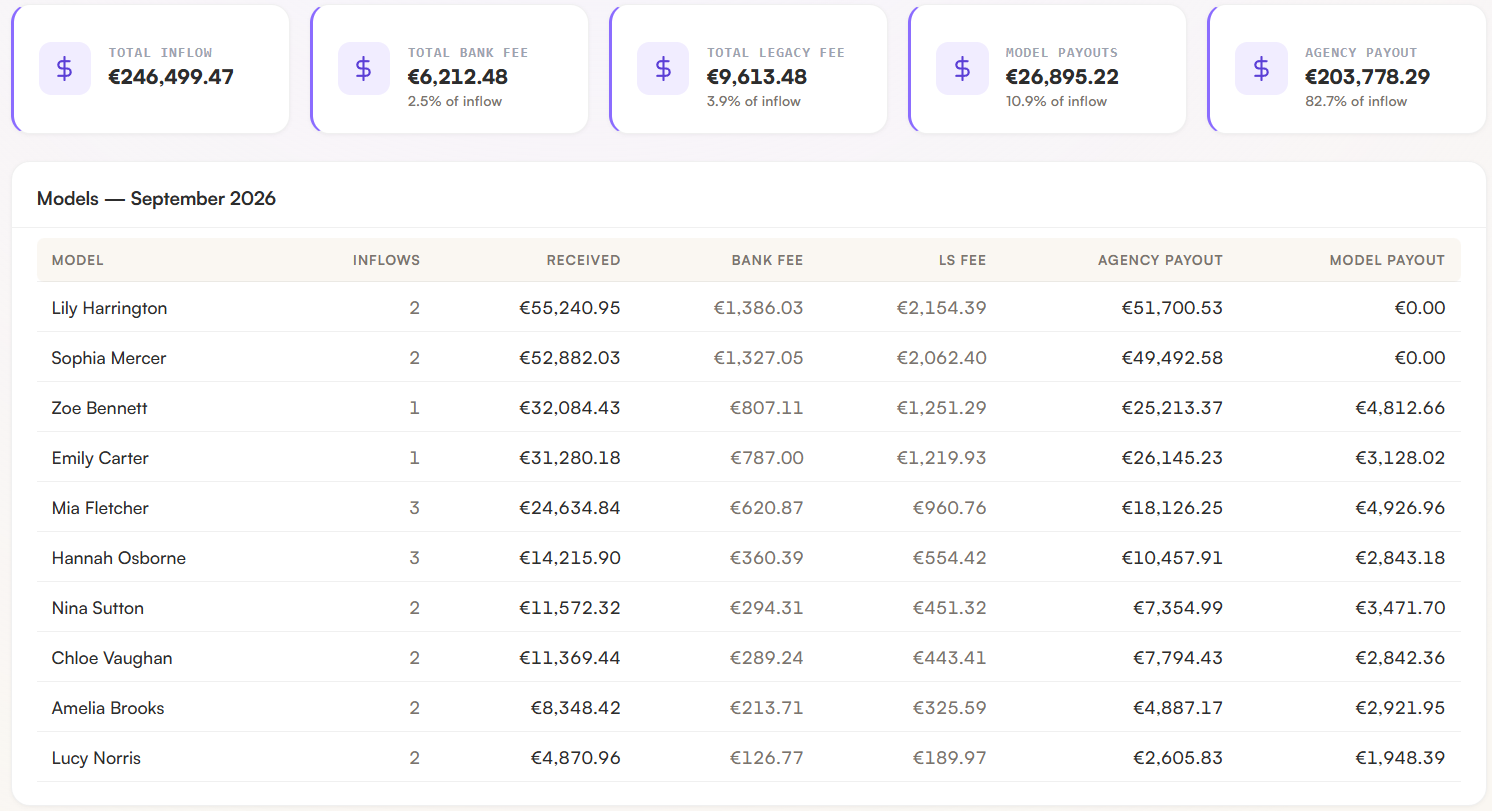
- Automated settlement. Once onboarding is verified, the payout flow runs on its own. The moment OnlyFans releases the cleared balance, funds route through a compliant banking node on the agency's normal weekly rhythm, not a separate manual process layered on top of it.
- Both shares settle separately, visibly, at the same moment. The agency's agreed split lands in its own business account. The model's share lands in hers. Neither side is calculating what the other is owed after the fact.
The result isn't that the model doesn't notice her earnings, it's that there's nothing left to notice after the fact. No invoice arrives days later asking for a cut of money she's already mentally accounted for as hers, because the split already happened before either side had to think about it. That's what actually removes the awkward Monday conversation, not concealment, timing.
By moving to bank-grade infrastructure instead of manual invoicing or grey-market wallets, an agency protects its margins, meaningfully reduces its legal exposure, and gets its team's time back for what actually grows the business, traffic, conversion, and scaling revenue on a foundation that doesn't depend on anyone forwarding money correctly by hand.
Frequently asked questions
Why does invoicing get riskier as a model's revenue grows, instead of easier?
Because the dollar amount being forwarded grows with her revenue, but the psychological weight of "giving back" a large chunk of a large deposit grows faster than the percentage itself. The structure, not the relationship, is what creates the friction.
Is it legal for an agency to automatically split a model's OnlyFans payout?
Yes, when the split is executed by a licensed banking partner based on an agreed contract, with each party holding their own account. It becomes a legal problem specifically when an agency controls an account that isn't legally its own, not because a percentage is being taken.
Does removing the invoice step mean the model has less visibility into her earnings?
No, it should mean the opposite if it's built correctly. Both the agency and the model should see the same live numbers, her share and the agency's share, reconciled the same way every time. The goal is removing the manual forwarding step, not the model's visibility into her own numbers.
What's the actual risk of running a model's e-wallet on her behalf to avoid this?
Operating an account that isn't legally the agency's is a real legal exposure on its own, separate from any dispute over the split itself, and it tends to hit practical limits, holds, freezes, verification triggers, as volume grows, regardless of intent.