
Take a look at your calendar every Monday morning.
If you're running a standard OnlyFans management agency, a real block of that time isn't spent analyzing traffic funnels, optimizing PPV scripts, or scouting new creators. It's spent playing polite debt collector.
Log into the dashboards, pull the weekly payout logs, open the spreadsheet, calculate the splits, draft individual invoices, send a wave of WhatsApp or Telegram messages that all sound roughly the same:
"Hey! Hope you had a great weekend. Just checking if the OnlyFans payout hit your account yet so we can square up last week's management fee 🙏"
On paper, this looks like routine business administration. In practice, it's a quiet operational tax that eats into margins, caps how far an agency can scale, and, done long enough, wears on the relationships it depends on. Here's the actual cost of running an agency on manual tracking and good faith, and why moving to automated infrastructure stops being optional past a certain size.
The hidden time burn
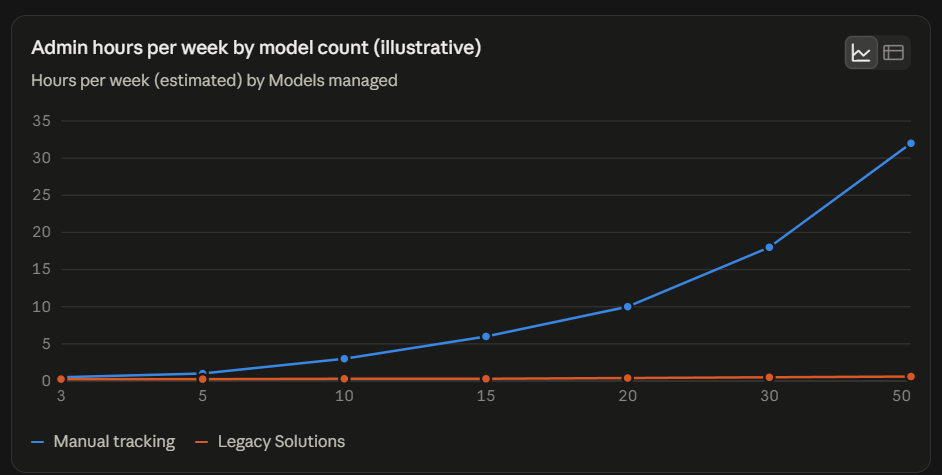
At two or three models, manual invoicing feels fast, maybe 30 minutes a week. Past that, manual administration doesn't scale linearly, it scales exponentially.
The math changes noticeably around 15 models:
- Reconciliation. Fifteen separate payout reports need to be manually checked against internally tracked chatter sales to catch any miscalculated tips or PPV unlocks.
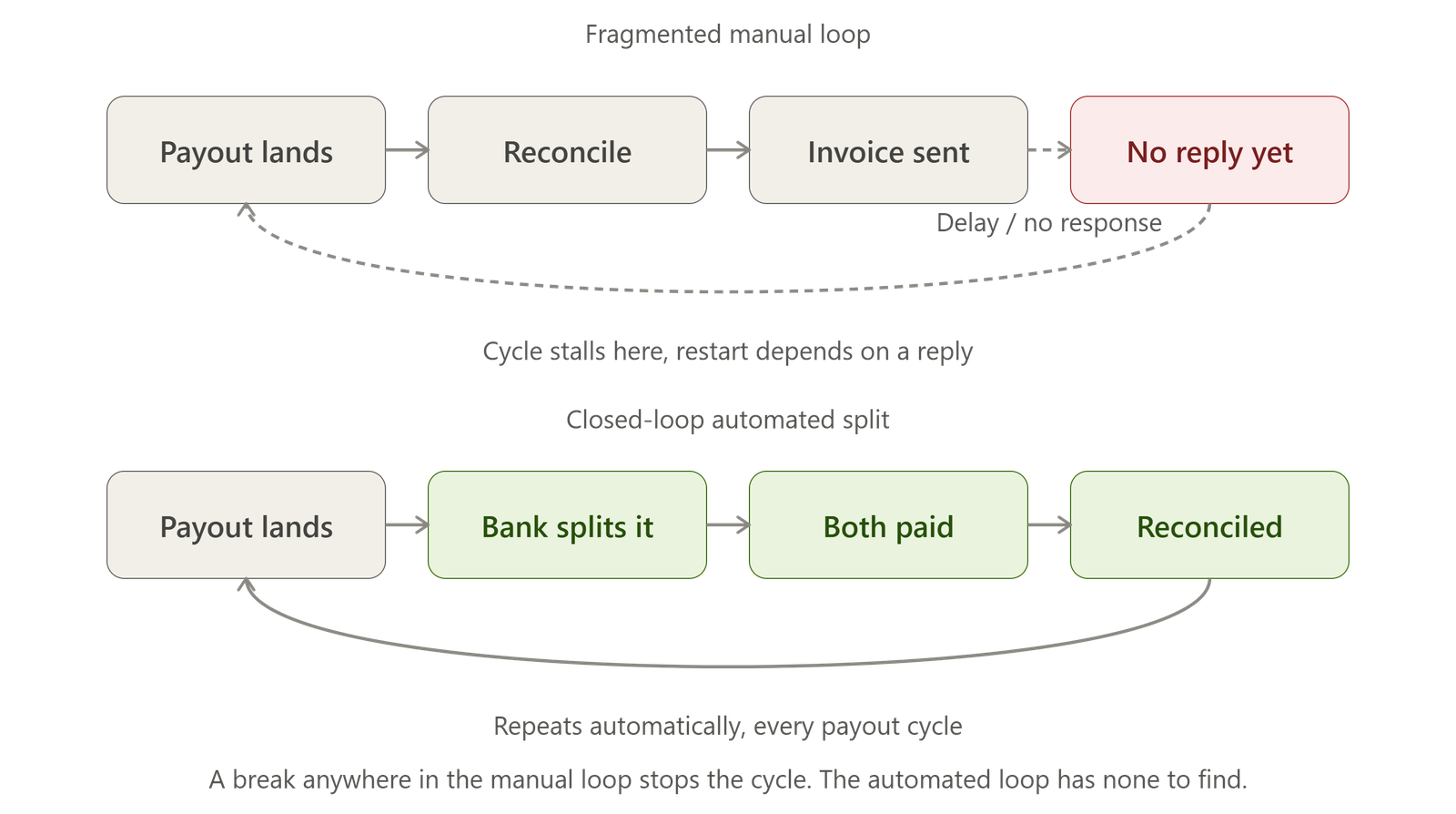
- The follow-up loop. Out of 15 models, a handful pay instantly. A handful more forget until midweek. The rest need repeated check-ins, traveling, a banking issue, or simply not seeing the message.
- The chatter payout sync. Once commission is finally collected from the models, the whole process runs in reverse to calculate and distribute chatter commissions from it.
What started as a quick Monday task turns into a multi-day administrative load, hours that would otherwise go toward acquiring traffic or scaling the accounts already performing well.
The relationship shift: from partner to expense
The more expensive cost of manual invoicing usually isn't the time, it's the shift in how a creator starts to see the agency.
An agency wants to be seen as a growth partner, the team driving traffic, handling operations, and scaling a creator's income. But sending weekly payment reminders, following up on missing wires, and asking for screenshots of a bank balance changes that dynamic over time. Instead of an asset, the agency starts to look like a recurring expense, the one showing up every Monday to collect a share of money she's already looking at as hers. That friction is exactly what invites contract renegotiation, and exactly the opening a competing agency needs to offer a lower cut and look like the easier option.
The single point of failure
When a collection system depends entirely on manual verification and someone choosing to act, there's no structural protection against ordinary human error.
- The formula trap. One broken cell or misplaced decimal in a master spreadsheet can quietly cost real commission over several months before anyone notices.
- The delayed invoice penalty. If an invoice goes out two days late because someone was sick or behind, the model may have already started spending the gross payout. Collecting a share from an already-depleted balance is a harder conversation than collecting on time would have been.
Trust is a real and valuable part of a working agency relationship. It isn't infrastructure. A serious business doesn't run its primary revenue collection on whether someone remembers to check their phone and initiate a transfer on time.
The infrastructure standard
Handling 30, 50, or 100+ models without a large back-office administrative team means removing manual intervention from the billing cycle entirely, not making the manual process faster.
That's what Legacy Solutions is built around, not a tracking app with extra steps, and not an unvetted workaround, financial infrastructure built alongside licensed banking partners to execute revenue-sharing splits directly at the banking layer.
- Real identity verification. The agency goes through corporate onboarding, and each creator goes through a secure legal ID and KYC verification process, in line with standard financial compliance practice.
- Automated settlement. The moment OnlyFans releases the week's cleared earnings, the balance routes through a licensed banking node automatically, on schedule.
- Direct, separate routing. The agreed management fee lands directly in the agency's corporate account. The model's exact net share lands separately in hers. Neither side calculates or transfers anything manually.
No invoice goes out because there's nothing left pending to invoice, both shares were already final the moment the payout landed. That's what actually removes the friction, not that the model doesn't see what she's earning, but that there's no leftover step where either side has to chase, remind, or wait on the other. Margins stay protected, cash flow stays predictable, and the team's time goes back to the work that actually grows the agency.
Frequently asked questions
At what point does manual invoicing actually become a scaling problem?
Most agencies feel it start to bite somewhere around 10 to 15 models, when reconciliation, follow-ups, and chatter payout syncing stop fitting into a quick Monday task and start eating multiple days a week.
Does automating the split remove the need for any admin oversight at all?
No. It removes the manual calculation and collection step specifically. Agencies still review dashboards, handle exceptions, and manage the broader relationship, the work changes, it doesn't disappear.
Is it legal for an agency to automatically deduct its management fee this way?
Yes, when the split is executed by a licensed banking partner based on an agreed contract, with each party holding its own account. The legal exposure comes from an agency controlling an account that isn't legally its own, not from taking an agreed percentage.
How does this affect the agency's relationship with its creators, not just its admin load?
It removes the recurring Monday reminder that quietly reframes the agency as a collector rather than a partner. Both sides see the same settled numbers without either one having to ask the other for anything.