The short answer isn't the one most agencies expect, and it matters more than the long explanation. Here's why withholding a model's earnings is riskier than it sounds, and what to do instead.
The short answer, and why it's not what most agencies expect
Generally, no, not unilaterally, and not just as a matter of good practice, as a matter of real legal exposure. A model's share of her own OnlyFans revenue is her earned income, not the agency's money to hold as leverage. Deciding on its own to withhold or freeze that money because it believes a breach occurred, without a court order, an arbitration ruling, or a specific, narrowly defined contractual mechanism agreed in advance, exposes an agency to claims ranging from breach of contract to conversion of funds that were never legally the agency's to control.
This surprises agencies who assume a signed contract automatically gives them that authority. In most cases, it doesn't, having a contract that was breached gives an agency the right to pursue a remedy through the process the contract or the law actually provides, not the right to act as judge and enforcer of its own claim by taking control of someone else's money.
Whose money is actually being discussed
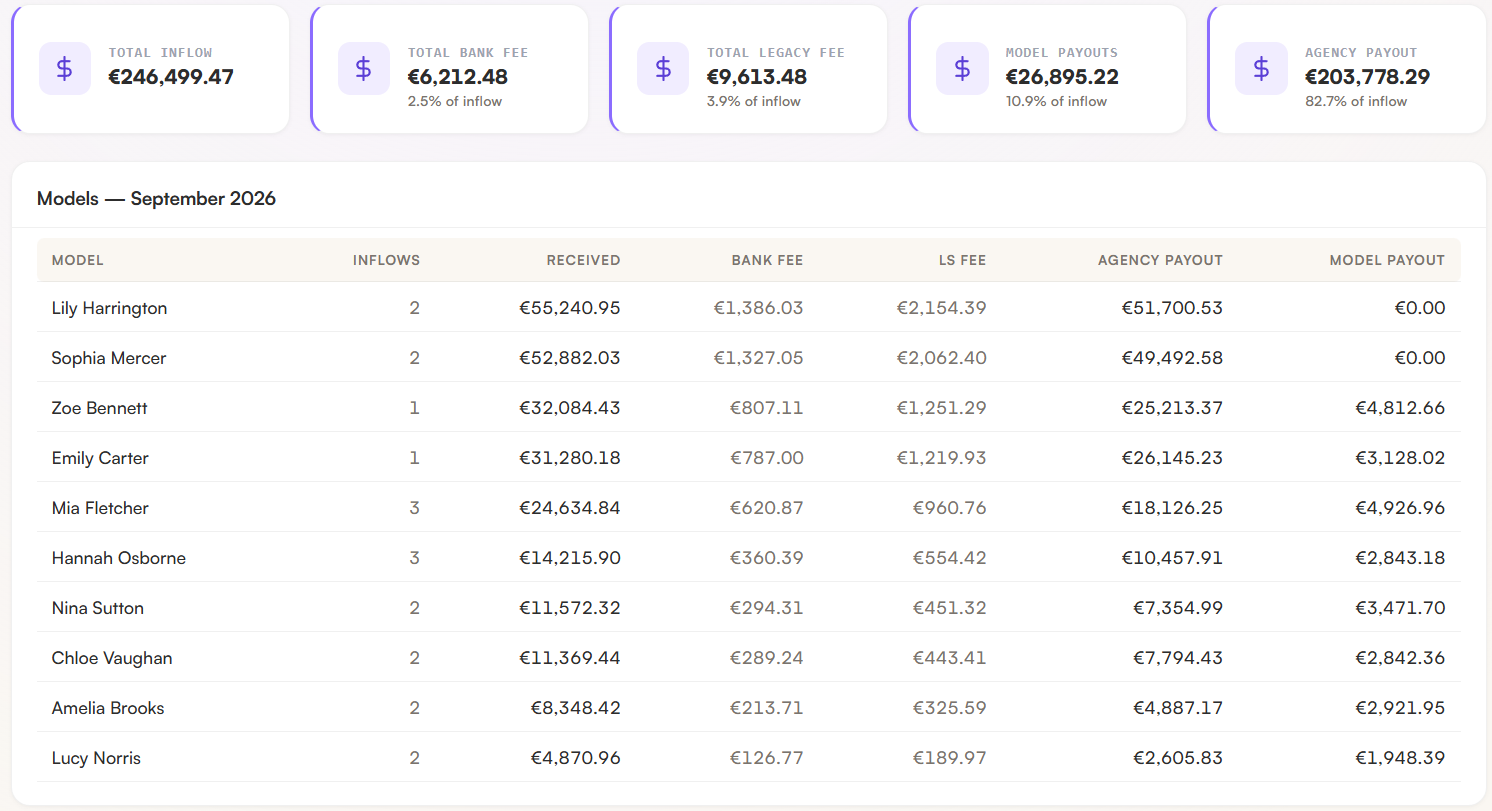
This question tends to blur two very different amounts together. The agency's own commission, its agreed percentage, is the agency's money once earned, and how an agency handles its own share is its own decision. The model's share is a different matter entirely, it's revenue she generated, due to her under the contract, and an agency was never the legal owner of it, even briefly, in a properly structured split.
"Freezing payouts" as a phrase tends to obscure which of these is actually being frozen. Pausing the agency's own future services or its own commission decisions is one thing. Withholding a model's already-earned share is a fundamentally different action with a fundamentally different legal profile.
- Agency's own commission. Whose money it is: the agency's, once earned. What the agency can decide unilaterally: its own business decisions about that share.
- Model's share of her revenue. Whose money it is: hers, once earned. What the agency can decide unilaterally: generally nothing, without a court order or a specific, pre-agreed mechanism.
Why unilaterally withholding a model's share is legally risky
Beyond the conceptual issue, there are practical reasons this tends to backfire. It converts a contract dispute, which an agency might otherwise have a reasonable position in, into a situation where the agency itself has taken an action that can be characterized as wrongful, sometimes more clearly wrongful than whatever the model was alleged to have done. It also tends to accelerate exactly the outcome the agency was trying to avoid, an ended relationship, likely followed by the model pursuing her own claim for the withheld amount, now with the agency defending its own conduct rather than pursuing the original breach.
What agencies can legitimately do instead
- Pause or end future services. An agency generally can stop providing management, marketing, or promotion going forward if a model has breached the agreement, that's different from withholding money she's already earned.
- Pursue the contract's actual remedies. This means following whatever dispute resolution process the contract specifies, negotiation, mediation, arbitration, or court, rather than self-enforcing outside that process. See the companion article on contract enforcement for how this fits together with the payout structure itself.
- Use a properly structured, pre-agreed reserve, if one exists. Some payout structures include a defined reserve, held by the licensed banking partner under terms both parties agreed to in advance, for a specific, limited purpose like chargeback protection. This is meaningfully different from an agency deciding on its own, after the fact, to withhold funds, the terms and the neutral party holding the reserve are set before any dispute exists.
Why an automatic split structure makes this largely a non-issue
In a setup where each model holds her own dedicated account and the split executes automatically at the banking level, this question mostly doesn't arise operationally, because the agency was never in a position to freeze the model's share in the first place. Her portion goes to her account, verified and controlled by her, the moment revenue lands. The agency's only actual decisions are about its own share and its own future services, which is exactly the scope of unilateral action that's actually defensible.
What about the agency's own commission?
If the concern runs the other direction, protecting the agency's own commission if a model breaches, that's the enforcement problem covered in depth in the companion article on contract enforcement. The short version: operational enforcement, where the agency's share is already settled automatically rather than dependent on the model forwarding it, addresses this more reliably than any freeze or pause ever could, because there's nothing to withhold in either direction.
Frequently asked questions
Can an agency withhold a model's payout if she stops responding or goes silent?
Generally no, not unilaterally. Non-responsiveness may be relevant to a separate dispute or to ending the business relationship going forward, but it doesn't, on its own, give an agency the legal right to withhold money she's already earned.
Can a contract clause give an agency the right to freeze a model's earnings?
This depends heavily on jurisdiction and how the clause is written, and some such clauses may not be enforceable even if signed, particularly where the underlying money isn't the agency's own. This is a question for a qualified lawyer reviewing the specific contract and jurisdiction, not something to assume from a template clause.
Is a chargeback reserve the same thing as freezing a model's payout over a dispute?
No. A properly structured reserve is a defined, limited holdback agreed by both parties in advance, held by a neutral party, for a specific purpose like chargeback risk. It's set up before any dispute exists and applies by predefined rule, not decided unilaterally by one party in response to a specific disagreement.
What should an agency actually do if it believes a model breached the contract?
Document the breach clearly, stop providing future services if appropriate, and pursue the contract's actual dispute resolution process, ideally with legal advice specific to the situation and jurisdiction, rather than unilaterally withholding money as a first response.