
QuickBooks and manual invoicing solve a real problem, they just don't solve the one an OFM agency actually has. Here's the difference, and what actually replaces each piece.
What QuickBooks and manual invoicing actually solve, and where they stop
QuickBooks and spreadsheet-based manual invoicing are both bookkeeping tools. They're built to record what happened financially, track expenses, generate invoices, and prepare the numbers an accountant needs at tax time. For that job, either one works fine, adult industry or not.
Neither one was built to answer the question an OFM agency actually has: how does a single incoming payout automatically become two separate, correctly calculated shares, on a recurring weekly basis, without someone manually doing that math and then manually sending a transfer. That's not a bookkeeping problem, it's a payment infrastructure problem, and no amount of better invoicing software solves it, because invoicing happens after the fact, describing a transfer that still has to happen separately.
Why QuickBooks specifically isn't built for this
Two different things get conflated when people ask about QuickBooks for this use case. QuickBooks as bookkeeping software has no restriction on being used by an adult-adjacent business, it's just software for tracking numbers. QuickBooks Payments, Intuit's own built-in payment processing service, is a different matter: Intuit's Acceptable Use Policy for its payment services explicitly excludes "adult services" and "adult novelties" as a prohibited business category.
In practice, this means an agency could theoretically use QuickBooks for its general bookkeeping and still be blocked from using Intuit's own payment processing for anything adult-adjacent. But even where that's not an issue, QuickBooks Payments was never built to split one incoming payout automatically between two parties in the first place, that's not what it does for any industry. So the restriction is almost beside the point, the core capability an agency needs isn't there regardless.
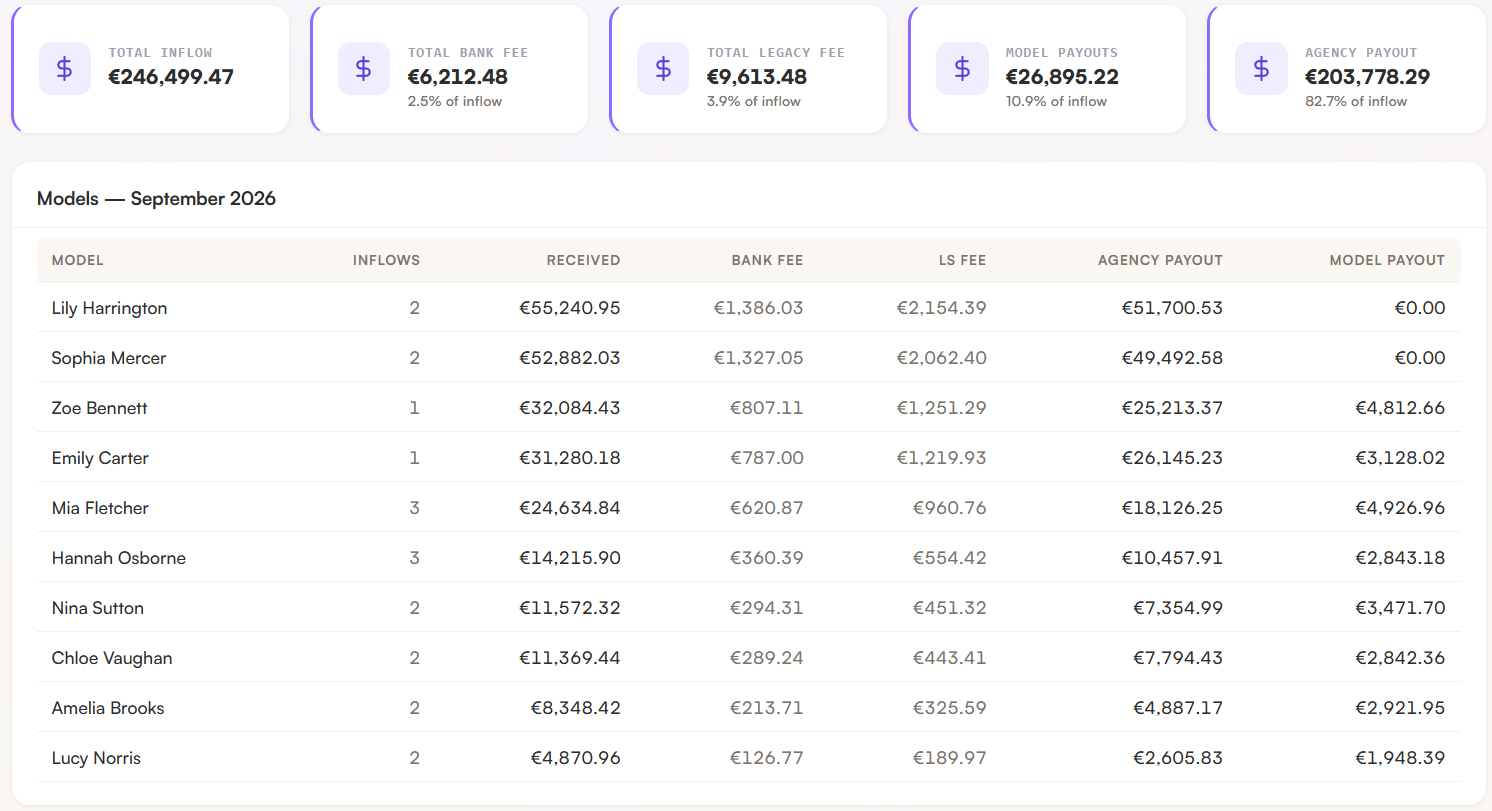
[Image: Legacy Solutions dashboard showing live payout data next to a manual spreadsheet-style ledger, illustrating the shift from tracking to automated splitting.]
The real alternative categories
"Alternatives to QuickBooks" tends to get answered with other bookkeeping software, which misses what's actually being asked. The honest breakdown looks like this:
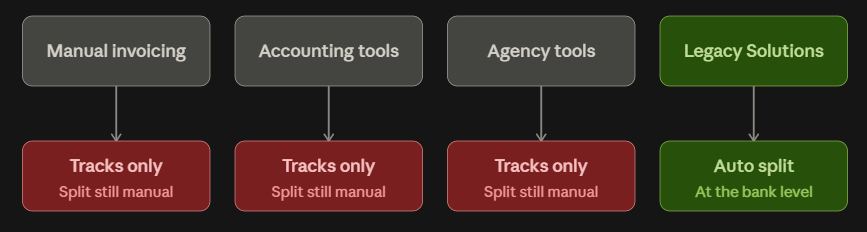
- Manual invoicing or spreadsheets. What it solves: basic record-keeping, works at very small scale. Where it stops: doesn't scale past a handful of models, and doesn't execute any actual split, it just tracks what should have happened.
- General accounting software (QuickBooks, Xero, and similar). What it solves: bookkeeping, expense tracking, tax preparation. Where it stops: none of these execute a payout split, they record numbers after the money has already moved through some other process.
- Generic agency management platforms. What it solves: content scheduling, messaging, model onboarding, and similar operational workflow. Where it stops: most of these track payout numbers for reporting purposes, they don't move or split money at the banking level.
- Automated split-payment infrastructure (Legacy Solutions). What it solves: the actual payout, split automatically at the banking level the moment revenue lands, with documentation generated as a byproduct rather than as a separate manual task.
Where Legacy Solutions actually fits
Legacy Solutions isn't a bookkeeping replacement, and it isn't trying to be. It solves the piece none of the categories above solve: each model holds her own dedicated account at a licensed banking partner, the agreed commission split executes automatically the moment revenue lands, and both the agency and each model get a live, itemized view of exactly what happened.
Most agencies still want a general accounting tool, QuickBooks or otherwise, for tax filing and broader expense tracking, and that's a reasonable setup. The difference is that the payout itself is no longer something manually calculated and manually transferred before it ever reaches a spreadsheet, it's already correct and already documented by the time anyone needs to record it for accounting purposes.
What to look for when evaluating alternatives
- Does it execute the split, or just track it? A tool that generates a report showing what each party is owed still leaves the actual transfer as a manual step. A tool that executes the split changes who has to act.
- Does it work for adult-adjacent businesses specifically? General bookkeeping software may work fine for record-keeping, but check its payment processing arm separately, as the QuickBooks example shows, the two aren't always the same policy.
- Does documentation come out the other end automatically? If reconciling the books still requires manually cross-referencing a separate payout record, the tool hasn't actually removed the manual step, it's moved it.
- Does it scale without adding admin per model? Manual invoicing and most spreadsheet systems add real work with every model added. A properly automated split shouldn't.
Frequently asked questions
Can an OFM agency use QuickBooks at all?
Yes, for general bookkeeping and tax preparation there's no restriction on the software itself. The limitation is specifically on Intuit's own payment processing service, which excludes adult-adjacent businesses, and separately, QuickBooks was never built to execute a multi-party payout split regardless of industry.
Is manual invoicing ever good enough for an OFM agency?
At very small scale, two or three models, it's workable, if inefficient. Past that, the time cost of chasing and reconciling manual invoices tends to outweigh whatever setup cost comes with a more automated alternative.
Do agencies still need an accountant or bookkeeping software if they use Legacy Solutions?
Generally yes. Legacy Solutions handles the payout split and its documentation, it doesn't replace broader bookkeeping, tax filing, or accounting work, which most agencies still handle through a general accounting tool or an accountant.
What's the actual difference between an agency management platform and a payout splitting tool?
Agency management platforms typically handle operational workflow, content scheduling, messaging, model onboarding. Payout splitting tools handle the financial mechanics of dividing revenue automatically. Many agencies use both, since they solve different problems.