
Manual tracking and automated splitting solve the same problem on paper. In practice, one of them keeps working as an agency grows and one of them doesn't. Here's the comparison agencies actually need before choosing.
What manual tracking actually involves
Manual tracking usually means a spreadsheet, one row per payout, columns for gross revenue, the agreed percentage, and the calculated split. Someone updates it when a payout lands, calculates each model's share, and either sends an invoice or waits for a transfer, depending on which direction the money is supposed to flow.
This works. It's also entirely dependent on someone doing it correctly, every time, on schedule, for every model, indefinitely. The spreadsheet doesn't fail, the process around it does, a missed update, a formula error, a payout that arrives on a day nobody checked the sheet.
What automated platform-integrated splitting actually means
"Platform-integrated" is the distinction that matters here, and it's often the part left vague in comparisons. It doesn't just mean software that calculates a split faster than a person would. It means the split is defined once, at the account level, and executes automatically the moment revenue lands, at the banking layer itself, not in a spreadsheet that gets updated after the fact.
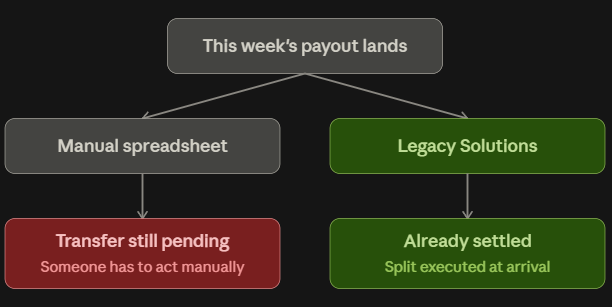
The practical difference: with manual tracking, the spreadsheet describes what should happen. With platform-integrated splitting, the split has already happened by the time anyone looks at a dashboard, the software is showing a record of something completed, not a to-do list of transfers still owed.
The comparison, dimension by dimension
- Speed. Manual: each payout requires someone to calculate and act, typically hours to days depending on workload. Automated: the split executes the moment revenue lands, no waiting on a person's availability.
- Error rate. Manual: every calculation is a chance for a transposed number or a missed row, especially across dozens of models. Automated: the same percentage rule applies identically every time, removing the most common source of payout errors.
- Scalability. Manual: each additional model adds direct, ongoing admin work. Automated: adding a model doesn't meaningfully change the weekly workload, the same rule just applies to one more account.
- Documentation. Manual: only as complete and consistent as whoever's maintaining the spreadsheet that week. Automated: every split generates a reconciled record automatically, the same format every time.
- Dispute risk. Manual: disagreements over "what was I supposed to receive" are common, since the model and agency may be working from different versions of the numbers. Automated: both sides see the same live numbers, reducing the room for genuine disagreement about what happened.
- Legal exposure. Manual: often involves an agency operating a model's payout method directly to solve the collection problem, which carries real legal risk. Automated: each party holds their own account, with the split executed by a licensed banking partner rather than either party controlling the other's funds.
Where manual tracking still makes sense
Worth being honest about this: at one or two models, a spreadsheet is a reasonable choice. The volume is low, the relationship is likely closer, and the cost of setting up anything more automated may not be worth it yet. Manual tracking isn't wrong, it's a tool that fits a specific scale and stops fitting past it.
The harder question is knowing when that point has been crossed, and most agencies notice well after the fact, once a missed payout or a drawn-out dispute has already cost more than switching earlier would have.
The real cost of manual tracking at scale
The cost of manual tracking isn't just the hours spent on it, though that adds up fast, an agency with 30 models easily spends several hours a week on reconciliation and invoicing alone. The bigger cost is what happens when it goes wrong: a missed payout that damages trust with a model, a dispute that takes days to resolve because the agency and model were looking at different numbers, or commission that simply never gets collected because the invoice went out too late to matter.
None of those costs show up as a line item, which is part of why manual tracking often survives longer than it should, the cost is real but distributed across a dozen small frustrations rather than one obvious expense.
Where Legacy Solutions fits
Legacy Solutions is built as platform-integrated splitting in the specific sense described above: each model holds her own dedicated account at a licensed banking partner, the agreed split executes automatically the moment revenue lands, and both the agency and each model see the same live, reconciled numbers. Nobody is updating a spreadsheet to keep up with what already happened at the banking level, the dashboard is showing that record directly.
What to check before switching from manual tracking
- Does the new system execute the split, or just track it faster? Software that calculates a split quickly but still requires someone to send a transfer afterward hasn't actually removed the manual step, it's just sped up the tracking half of it.
- Does documentation stay consistent automatically? A system worth switching to shouldn't require someone to manually build a report after the fact, that record should already exist.
- Does it scale without adding admin? Ask specifically what changes operationally between managing 5 models and managing 50 under the new system, if the answer is "nothing," that's the right answer.
Frequently asked questions
At what point does manual tracking stop being viable for an agency?
There's no fixed number, but most agencies notice the strain somewhere between 10 and 20 models, when weekly reconciliation starts taking real, dedicated time rather than a few minutes between other tasks.
Is automated splitting more expensive than manual tracking?
Manual tracking has no direct software cost, but it has a real time cost that scales with model count, plus the harder-to-quantify cost of errors and disputes. Automated splitting typically has a direct cost but removes both of those ongoing costs, which is usually the more relevant comparison past a certain scale.
Does automated splitting remove the need for any human oversight?
No. It removes the manual calculation and transfer step specifically. Agencies still review dashboards, handle exceptions, and manage the broader model relationship, automation changes what the work is, not whether any oversight is needed.
Can an agency switch from manual tracking to automated splitting mid-relationship with a model?
Generally yes, since it's a change in how an already-agreed split gets executed, not a change to the agreement itself. The transition typically involves setting up the model's dedicated account and confirming the agreed percentage in the new system.