
Drafting an agency management agreement without explicit financial mechanics guarantees a payout dispute the moment revenue spikes. Protecting your commission requires converting vague payment promises into enforceable, quantitative contract clauses.
Diagnostic: testing your current contract terms
Run your current management contract through this operational diagnostic to identify financial vulnerabilities before a dispute occurs:
- If your split is defined as "net revenue" without line-item fee definitions: the model may be able to argue that platform processing fees and chargebacks were deducted without authorization.
- If your agreement lacks a specific settlement window: a payout delay could potentially be treated as a breach, depending on how the contract and applicable law define materiality.
- If expense approvals are handled over messaging apps: informal chat approvals may not hold up as valid contract amendments in some jurisdictions, particularly if the contract requires written amendments.
- If financial records are kept in private agency spreadsheets: a model may request an independent accounting review, which can complicate or delay resolving a dispute.
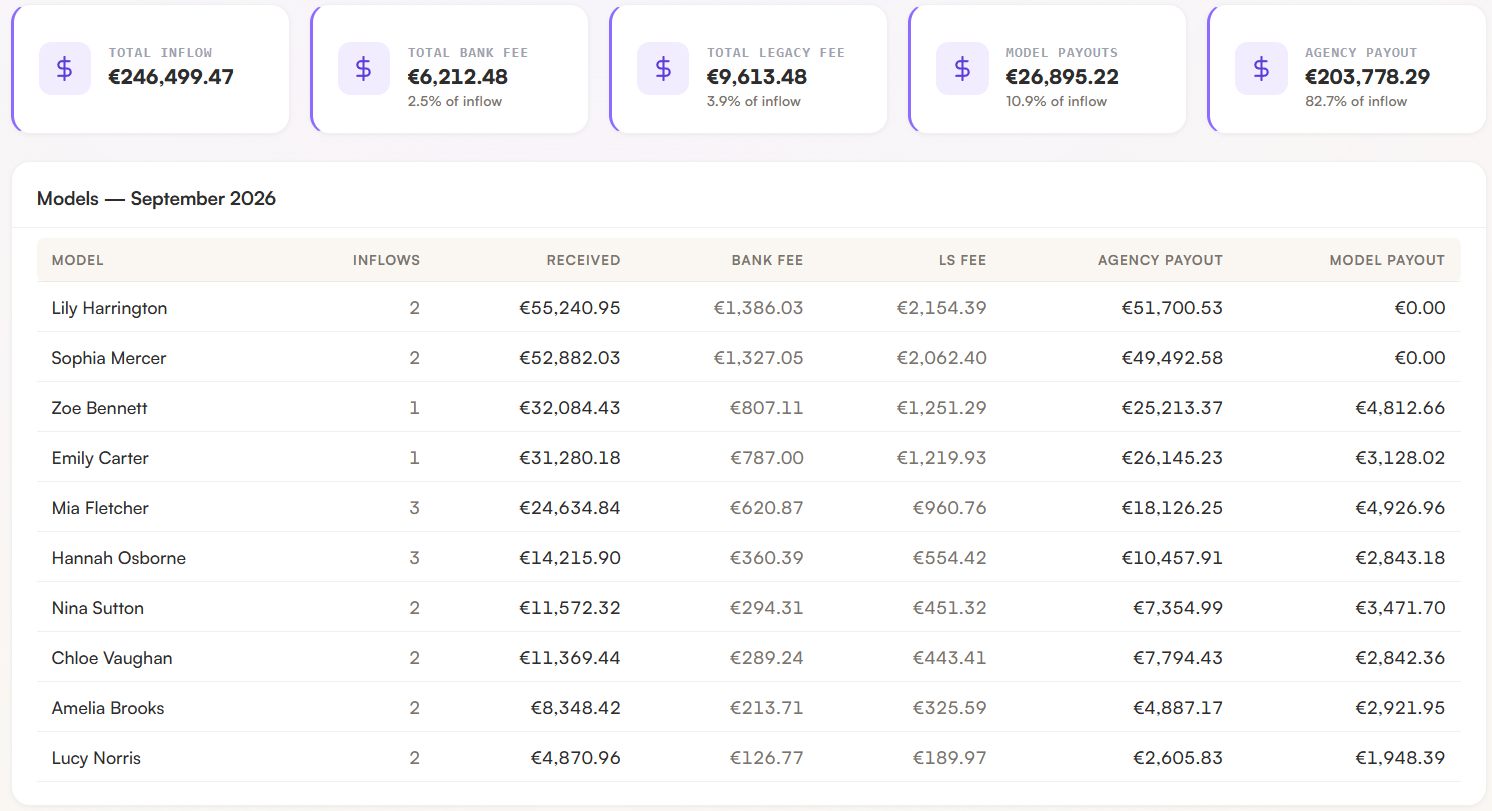
The 4 payment clauses worth getting right
1. The mathematical net revenue definition
Avoid using standard accounting phrases like "net profit." Consider having your contract explicitly state something close to: "Net Revenue equals Gross Inflows received from the platform, minus platform transaction fees, third-party processing charges, and chargeback reserves." A lawyer should confirm this exact language against the specific platform's fee structure and your jurisdiction.
2. Line-item deduction authorization
List every category of expense the agency intends to recover. Common items include banking wire fees, software infrastructure costs, currency conversion margins, and direct marketing expenses. An expense category left out of the signed agreement is much harder to justify deducting later, regardless of how routine it seems operationally.
3. Settlement cadence and grace period
Specify the exact payout frequency, preferred payout method (such as SEPA or direct wire), and an operational grace period. Sample language to have reviewed: "Payouts are calculated weekly every Monday. The agency maintains a 3-business-day grace period to accommodate banking processing delays before any payout is classified as overdue."
4. Unified ledger and statement verification
Establish a single source of financial truth. Consider requiring both parties to accept automated, itemized weekly statements as the agreed record of earnings, fees, and splits, with a defined objection window (for example, 14 days) after statement delivery. Whether an unreviewed statement becomes legally "final" after that window depends on how the clause is drafted and the applicable jurisdiction, this is a specific point worth confirming with a lawyer rather than assuming from a template.
Contract redline matrix: vague vs. more specific clauses
- Percentage split. Vague: "Agency earns 40% of all model revenue." More specific: "Agency earns 40% of Net Revenue, calculated and distributed on a weekly settlement cycle."
- Platform fees. Vague: "Costs are deducted prior to payout." More specific: "Gross inflows are reduced by mandatory platform processing fees (e.g., 20% platform fee) prior to percentage division."
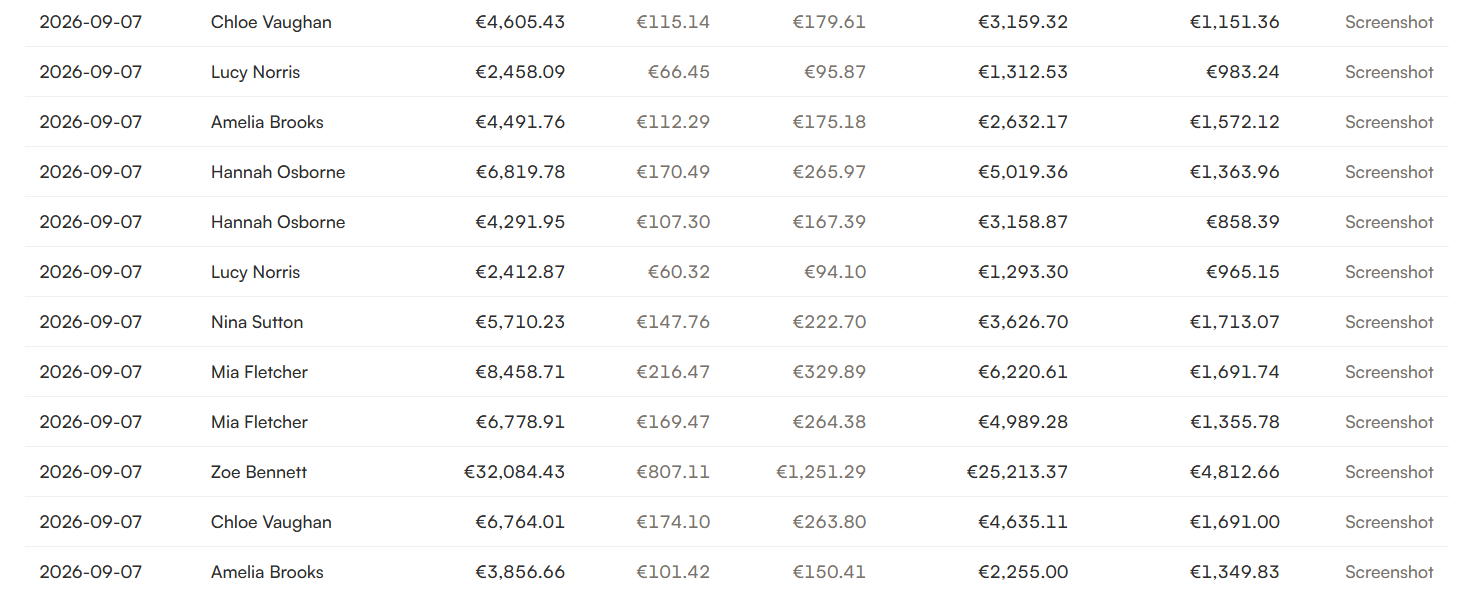
- Banking expenses. Vague: "Agency covers transfer costs." More specific: "Transaction-level banking fees and currency conversion charges are deducted as direct pass-through costs."
- Dispute resolution. Vague: "Payout errors will be fixed." More specific: "Creator must file written accounting objections within a defined period of statement generation, per the process a lawyer has confirmed is enforceable in the relevant jurisdiction."
Encoding contract terms into payout software
Written payment terms only protect your agency if they're executed accurately at payout time. Relying on manual spreadsheet math to calculate gross inflows, pass-through bank fees, and tiered percentage splits introduces human error and creates grounds for disputes that have nothing to do with whether the contract itself was well drafted.
Integrating contractual payment terms directly into automated financial software means every gross inflow is divided at the banking layer according to the agreed rules, with bank fees, software service fees, and agency shares calculated consistently and producing exportable statements that document exactly how each figure was reached.
Frequently asked questions
What is the safest way to define payment splits in an OFM contract?
Define the split using specific, mathematical terms based on Net Revenue, explicitly listing the deductions (platform fees, bank charges, chargebacks) that come out before the percentage split occurs, and have the specific wording reviewed by a lawyer for your jurisdiction.
Can an agency change commission splits after the contract is signed?
Generally, changes should go through a formal written amendment signed by both parties. Whether an informal agreement made over chat or email would also be treated as binding depends on the contract's own terms and the applicable jurisdiction, this varies more than it might seem and is worth confirming rather than assuming.
How should banking and wire fees be allocated in a management agreement?
Banking and wire fees are commonly defined as pass-through transaction costs deducted from gross inflows before the percentage split, so both parties share the actual cost proportionately rather than one side absorbing it unexpectedly.